

At Sharelesh Trading Academy, we believe trading education should go beyond buy and sell signals. That’s why we help students understand the real economic factors behind market movements, including inflation, forex reserves, currency strength, and global market impact.
Our goal is to help students develop practical market understanding and disciplined decision-making rather than depending completely on social media tips or random signals.
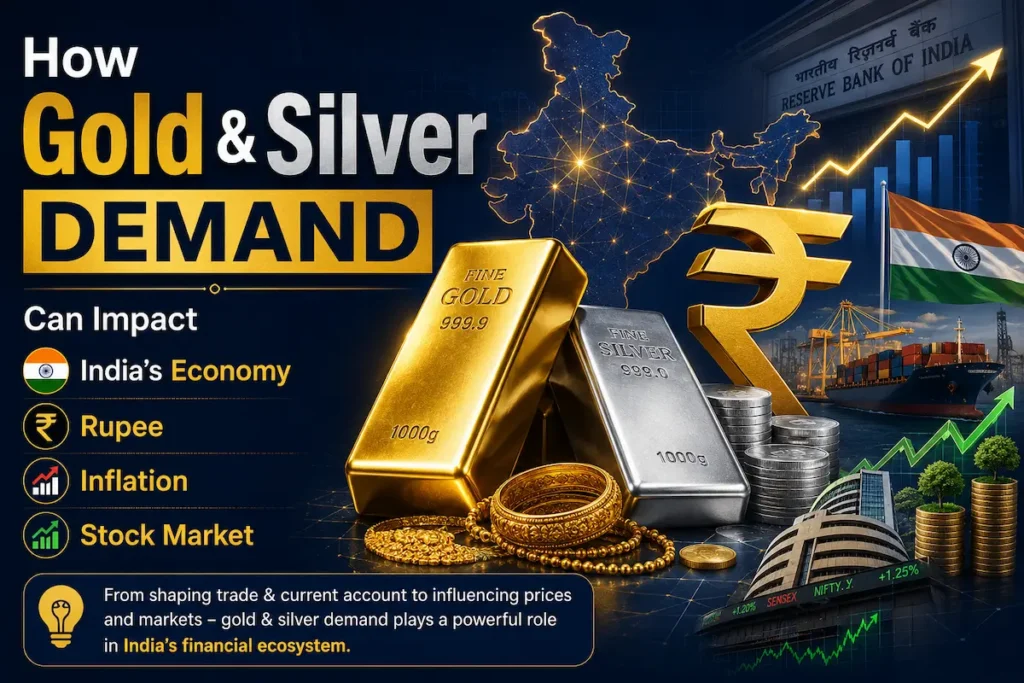
In recent times, there has been growing discussion around how increasing demand for gold and silver can impact India’s economy. Many people hear terms like forex reserves, dollar strength, rupee weakness, and inflation in the news, but very few truly understand how all these things are connected.
For traders and investors, understanding these economic concepts is extremely important because they directly influence:
- the Indian stock market
- inflation
- petrol prices
- currency value
- and overall
- economic stability
In this blog, we will understand in simple language:
What Are Forex Reserves?
Think of India as a big household that has a separate “Dollar Wallet.”
Whenever India buys something from other countries — like crude oil, gold, electronics, or machinery — we cannot directly pay in Indian Rupees because most countries do not accept rupees for international trade. The global market mainly uses US Dollars for payments.
So before making any international purchase, India first has to convert its rupees into US Dollars. These dollars come from India’s “Foreign Exchange Reserves,” commonly called Forex Reserves.
Forex reserves are basically a collection of:
- foreign currencies (mainly US Dollars)
- gold reserves
- and special reserve assets from the International Monetary Fund (IMF), known as SDRs (Special Drawing Rights).
These reserves are managed by the Reserve Bank of India (RBI) and play a very important role in keeping the country’s economy stable.
$691B
Total Forex Reserves (March 2026)
$728B
Total Forex Reserves (March 2026)
$40B+
Total Forex Reserves (March 2026)
11 Mo.
Total Forex Reserves (March 2026)
$691 billion sounds comfortable, right? But here’s what most people miss. When RBI’s forward book commitments (dollar liabilities already promised) are adjusted, the effective import cover drops from 11 months to just 9 months. What you see is not what’s actually available.
And on top of that — reserves were at an all-time high of $728 billion in February 2026. They fell by over $40 billion in just a few weeks. That pace of decline is seriously alarming
The Gold Import-Dollar Connection -This Is Where the Real Problem Starts
Now we get to the point that explains why Modi ji made this appeal. And fair warning — this might make you feel a little guilty. Because we’re all part of it.
India is the world’s second-largest gold buyer — right after China. Almost all the gold we buy is imported. And gold’s price in the international market is denominated in US dollars. That means every time India imports gold — every biscuit, every chain, every ring — we spend dollars from our forex reserves.
THINK ABOUT IT THIS WAY
Your neighbour Sunita Aunty bought a ₹5 lakh gold set at a wedding. It seems like the money went to a local jeweller. But in reality, that transaction pulled roughly $5,900 out of India’s forex reserve — dollars that are no longer available.
When India imports gold and silver:
- Payment is made in US Dollars
- Dollars are used from India’s forex reserves
- Forex reserves may gradually decline if imports remain high
If imports continuously increase while exports remain lower, India needs more dollars to sustain trade.
This increases demand for the US Dollar.
How Dollar Demand Rises and the Rupee Falls
This is the part most people miss — and once you understand it, the entire economy starts making sense. It’s a simple supply-demand game with massive consequences:
THE DOMINO CHAIN
India Imports Gold: We pay foreign exporters in dollars. Dollar demand increases in the market.
Rupee Holders Rush to Buy Dollars: Indian importers sell rupees and buy dollars to make payments. As dollar demand rises, the dollar becomes more expensive.
The Rupee Weakens: Expensive dollar means cheap rupee. The rupee hit an all-time low of ₹94.82/$ in March 2026 — already down 5% in 2026.
RBI Burns Through Forex Reserves: RBI sells dollars in the market to stabilize the rupee. This further depletes the reserves.
Everything Gets More Expensive — Inflation: A weak rupee means oil, electronics, and machinery cost more. Imported inflation is already at 5.4%, and CPI is expected to stay above 4.5%.
Inflation - A Direct Attack on Your Wallet
Inflation in India 2026 — The Invisible Tax That Hits You Before You Even Notice
Let’s talk about something that affects every single one of us — whether you follow the stock market or not, whether you understand economics or not.
You didn’t get a pay cut. But somehow, the same ₹10,000 that used to last the whole month now runs out by the 20th.
That’s not bad luck. That’s inflation — and specifically, the type of inflation that India is dealing with right now is called Imported Inflation. And it is directly connected to everything we’ve discussed so far — gold imports, forex reserves, and a weakening rupee.

What It Looks Like in Real Life
This is not an abstract number on a government report. This is your actual daily life:
Petrol Pump pe jaao – You notice petrol is Rs 4-5 more per litre than last year. You think “government ne daam badhaaye.” But actually, the rupee got weaker, so the same imported oil costs more in rupees even if global crude prices stayed the same.
Sabzi mandi mein jaao – Tomatoes, onions, everything slightly pricier. Why? Because transport costs went up. Diesel is costlier. Trucks charge more. Farmers charge more to cover their costs. The chain flows down to your plate.
Phone ya laptop khareedna ho – That new phone you’ve been eyeing? It’s Rs 3,000 – 5,000 more expensive than 18 months ago – not because Apple or Samsung changed the price, but because the components are imported, priced in dollars, and a weaker rupee makes every dollar cost more rupees.
Bahar padhne ya travel karna ho – Your child’s overseas education just got 10-15% more expensive not because the university raised fees, but because the dollar is stronger against the rupee. A 20,000 annual fee that cost Rs 16.6lakh at Rs 83/20,000 annual fee that cost Rs 16.6 lakh at Rs 83/ 20,000annualfeethatcostRs 16.6lakh at Rs 83/ now costs Rs 18.8 lakh at Rs 94/$. That’s Rs 2.2 lakh extra just from currency movement.
Every percentage point the rupee falls, inflation climbs. It’s not a coincidence, it’s cause and effect.
NEGATIVE IMPACTS - WHAT A WEAK RUPEE DOES TO YOU
- ↓ Petrol and diesel prices rise (oil is imported in dollars)
- ↓ Electricity bills increase (coal and LNG are imported)
- ↓ Electronics – phones, laptops – become more expensive
- ↓ Foreign travel and overseas education costs skyrocket
- ↓ Company production costs rise → goods get pricier for everyone
↓ FIIs pull money out of Indian stock markets → Sensex and Nifty fall
Why Most People Don't See It Coming
Here’s the brutal truth inflation doesn’t announce itself. It doesn’t send you a message saying “hey, your purchasing power just dropped 8%.” It creeps in slowly:
- Your grocery bill goes from Rs 4,000 to Rs 4,300 you just think “prices bade hain”
- Your EMI gets slightly harder to manage you just think “thoda tight month hai”
- Your savings feel smaller every year you just think “kharcha zyada ho gaya”
But it’s not your spending that changed. It’s the value of your money that shrank.
This is exactly why understanding forex reserves, gold imports, and rupee movement is not just “finance gyaan for rich people.” It is survival knowledge for every working Indian.
RBI Bought 86 Tonnes of Gold While You Were Told Not To - Is the Government Lying?
Here’s an angle that confuses a lot of people and honestly, the confusion is valid. While PM Modi is asking citizens to stop buying gold, the RBI was quietly accumulating gold at the same time. Wait, what?!
RBI’s gold buying is a long-term strategic reserve diversification move reducing dollar dependence and hedging against geopolitical risk. RBI’s gold is a sovereign asset, funded through balance sheet restructuring, and it actually strengthens international reserves.
Private retail gold imports you and me buying jewellery come through commercial channels, directly drain forex reserves, widen the current account deficit, and create dollar demand in the open market. Modi ji’s appeal was specifically about this private demand.
SIMPLE ANALOGY
Think of the family budget — Dad makes a fixed deposit for long-term savings while asking everyone to stop eating out to cut monthly expenses. Both decisions serve different purposes. It’s not a contradiction — it’s strategy.
How Does Weak Rupee and Falling Forex Reserves Impact Sensex, Nifty and Your Investments in 2026?
1. Higher Inflation Can Pressure Companies
When inflation rises:
- business costs increase
- transportation becomes expensive
- profit margins may shrink
This can negatively impact many sectors.
2. RBI May Increase Interest Rates
To control inflation, RBI may:
- increase repo rates
- make loans more expensive
This can affect sectors like:
- banking
- real estate
- automobiles
3. Some Sectors May Benefit
Certain sectors like:
- IT companies
- export-based businesses
may benefit because they earn revenue in US Dollars.
When the dollar strengthens, their earnings in rupees may increase.
What Traders & Investors Should Learn From This
Many beginner traders focus only on charts without understanding the economic forces behind the market.
In reality:
- the US Dollar
- inflation
- RBI policies
- forex reserves
- crude oil prices
all influence market direction.
That is why at , we focus not only on trading strategies but also on helping students understand the economic structure behind the markets so they can make informed decisions instead of blindly following tips or social media hype.
We Said This Long Before Modi Ji Made It Official
This might sound like self-promotion — but it’s a point that genuinely matters to you as a learner. Long before this became mainstream news, long before gold prices were a national talking point, we were already teaching our students exactly these concepts. The dollar-rupee connection. The impact of gold imports on forex reserves. The link between current account deficit and inflation. How a weak rupee translates to a weaker stock market. These were part of our curriculum when the general public hadn’t even heard these terms. Today, when India’s Prime Minister himself publicly says ‘we must save foreign exchange by any means’ it is a validation of what we have been saying all along. Our students were not surprised. They were prepared. Because they understood why this day would come. And if you’re understanding this today — you’re not late. You’re ahead of most people around you. “Those who understand the economy first, always make better decisions — in the market, and in life. It’s never too late to start.” |
Disclaimer: The content shared on this blog is purely for educational and informational purposes related to the stock market and trading. We do not provide any financial advice, investment recommendations, or profit guarantees. Trading and investing involve market risk.