
What Social Media Never Tells Indian Beginners About Forex Trading
Open Instagram or YouTube right now and search “Forex trading India.” Within seconds, you will see it – screenshots of massive profits, traders holding laptops on beaches, reels promising Rs.50,000 a day from Forex trading with “just Rs.500 to start.” It looks easy. It looks exciting. It looks like something you are missing out on.
This is the world that most Indian beginners enter Forex trading from. And this is exactly why most of them lose money within their first few months.
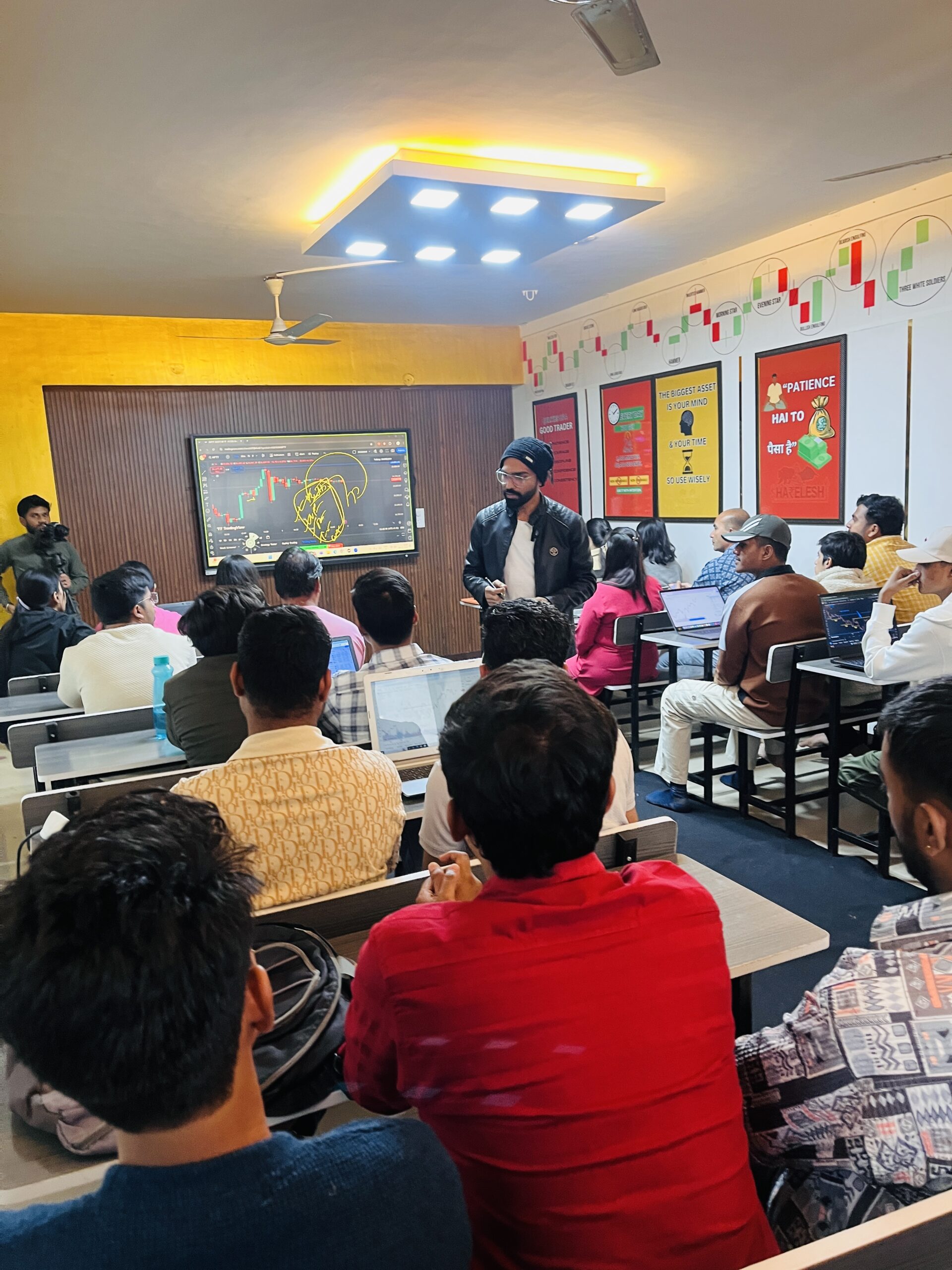
In my 17+ years as a trader and mentor, I have seen thousands of students walk into our institute after being misled by social media content about forex. They were not foolish people. They were hardworking individuals salaried employees, small business owners, homemakers, college students who genuinely wanted to grow their income. But the information they had consumed before coming to us was incomplete, misleading, and in many cases, dangerous.
Here is what social media never tells you: forex trading is a professional skill that takes months of learning and practice to develop. The people showing you profit screenshots are either showing you one lucky trade out of fifty, or they are selling you a course. The “Rs.500 se shuru karo” content is technically true and practically disastrous for anyone who follows it without proper education.
At our institute, our commitment is simple and non-negotiable: we teach only what is legal in India, we show you the complete picture – opportunities AND risks and we help you build a trading career the right way. Not the fast way. The right way.
This guide is written in that same spirit. Read it completely before you place your first forex trade.
What is Forex Trading? Meaning, Definition and How It Works in India
Forex trading, short for foreign exchange trading, is the buying and selling of one currency against another to profit from changes in the exchange rate between them.
Here is a simple example every Indian can understand. Imagine you exchange Rs.83,000 for $1,000 before travelling abroad. While you are away, the exchange rate shifts and the dollar strengthens. When you return, your $1,000 is now worth Rs.85,000. Without doing anything, you have made Rs.2,000 purely because one currency’s value changed against another.
Forex trading works on this exact principle, but it happens electronically, in real time, and at a much larger scale. The Forex market is the world’s largest financial market, with over $7.5 trillion traded every single day. Unlike the stock market, there is no central exchange for Forex. It operates through a global network of banks, financial institutions, and individual traders, 24 hours a day, five days a week.
For Indian traders, forex is accessible but within strict legal boundaries set by the Reserve Bank of India. Ignoring those boundaries is not just a financial risk. It is a legal one.
How the Forex Market Works - Currency Pairs, Pips, Lots and Market Structure Explained
Understanding how the forex market is structured will immediately separate you from 90% of beginners who jump in without this knowledge.
Forex Market Structure – Central Banks, Institutions and Retail Traders Explained
The forex market operates in layers. At the top sit central banks the RBI, the US Federal Reserve, the European Central Bank who influence currency values through monetary policy. Below them are large commercial banks, hedge funds, and institutional investors who execute billions of dollars in transactions daily. At the bottom of this pyramid sits the retail trader you and me.
This hierarchy matters because it tells you something important: the forex market is not designed around the retail trader. The big players move the market. Your job as a beginner is to learn to read those movements not fight against them.
What Are Currency Pairs in Forex Trading? Base and Quote Currency Explained
Forex is always traded in pairs. You are always buying one currency and simultaneously selling another. For example, USD/INR means you are trading the US Dollar against the Indian Rupee. The first currency is the base currency and the second is the quote currency. The price tells you how much of the quote currency is needed to buy one unit of the base currency.
What is a Pip in Forex? How to Calculate Profit and Loss
A pip is the smallest standard unit of price movement in a currency pair. For most pairs, one pip equals a price movement of 0.0001. Understanding pips helps you measure how much a trade has moved and calculate your exact profit or loss.
What is a Lot in Forex Trading? Standard, Mini and Micro Lots Explained
Forex trades are measured in lots. A standard lot equals 1,00,000 units of the base currency. For beginners, mini lots (10,000 units) and micro lots (1,000 units) are far more appropriate as they require less capital and carry smaller risk per trade.
What is Leverage in Forex Trading? Risk and Reality for Indian Beginners
If there is one concept in forex trading that is most misunderstood, most misrepresented on social media, and most dangerous in the hands of a beginner it is leverage.
Leverage allows you to control a position much larger than your actual capital. For example, with 10:1 leverage, you can control Rs.1,00,000 worth of currency with just Rs.10,000 in your account. Sounds powerful, right? Here is what those Instagram reels never show you.
A real example in Indian Rupees:
You deposit Rs.10,000 and use 10:1 leverage to take a Rs.1,00,000 position on USD/INR. The trade moves just 1% against you. That is a Rs.1,000 move on a Rs.1,00,000 position. But because you used 10:1 leverage, that Rs.1,000 loss is 10% of your actual Rs.10,000 capital. One small 1% move against you and you have lost 10% of everything you deposited.
Now imagine the social media content that shows “1:500 leverage available!” With 500:1 leverage, a 0.2% move against you wipes your entire account.
Leverage is not a shortcut to wealth. It is a multiplier and it multiplies losses just as aggressively as it multiplies profits. In my years of teaching, over leveraging is the single most common reason I see beginners empty their Forex accounts within weeks of starting.
Our rule for every student: Do not use leverage higher than 5:1 until you have at least six months of consistent profitable trading on a demo account. That advice alone, if followed, will save you from the mistakes that trap most Indian beginners.
Is Forex Trading Legal in India? RBI, SEBI and FEMA Rules Explained in Detail (2026)
This is the most important section of this entire guide. Please read it carefully.
The direct answer: Yes, forex trading is legal in India but only under specific conditions regulated by the Reserve Bank of India (RBI) under the Foreign Exchange Management Act, 1999 (FEMA).
Many Indians trade forex daily without any legal issues. But many others often unknowingly trade in ways that violate FEMA. The difference between the two is important to understand.
Where Can Indian Traders Legally Trade Forex? NSE, BSE and MSE Explained
Indian residents are permitted to trade forex only on SEBI-regulated exchanges. These are:
- NSE — National Stock Exchange
- BSE — Bombay Stock Exchange
- MSE — Metropolitan Stock Exchange of Indi
Any forex trading done through these exchanges, using a SEBI-registered broker, is completely legal.
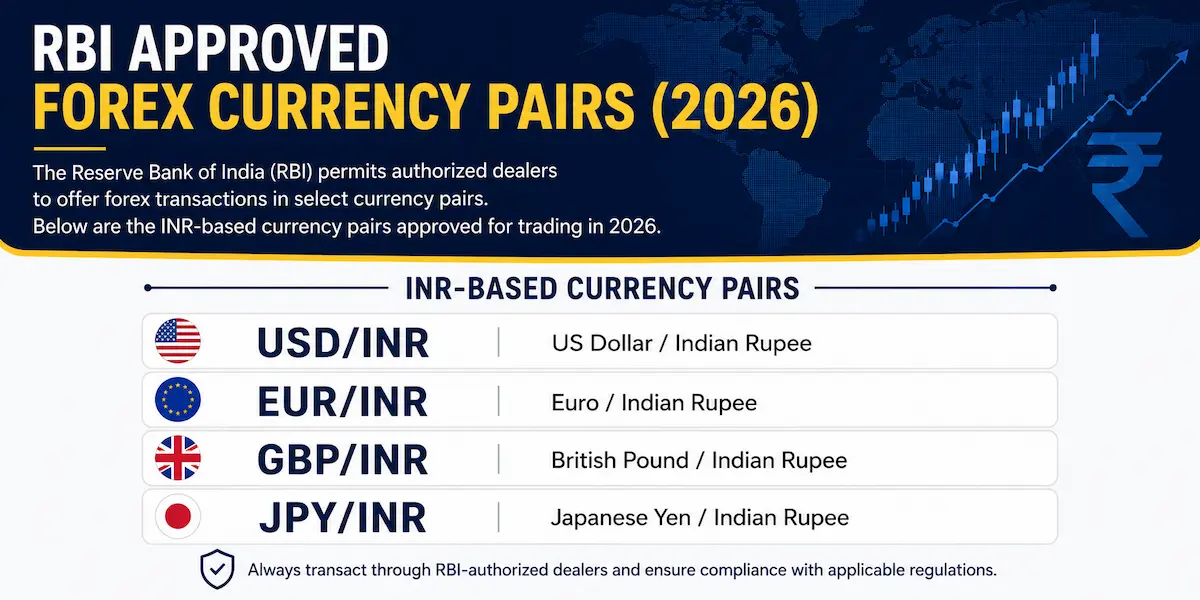
Legal Forex Currency Pairs in India – Complete RBI Approved List (2026)
Most beginners make their first legal mistake right here — they simply do not know which pairs they can legally trade. So here is the complete list as per current RBI and SEBI guidelines.
INR-Based Pairs (fully permitted):
- USD/INR – US Dollar vs Indian Rupee
- EUR/INR – Euro vs Indian Rupee
- GBP/INR – British Pound vs Indian Rupee
- JPY/INR – Japanese Yen vs Indian Rupee
Cross Currency Pairs (permitted on Indian exchanges):
- EUR/USD – Euro vs US Dollar
- GBP/USD – British Pound vs US Dollar
- USD/JPY – US Dollar vs Japanese Yen
These cross currency pairs were introduced by SEBI specifically to give Indian traders access to major global pairs while remaining within a regulated framework.
What is Illegal in Forex Trading in India? Offshore Brokers and FEMA Violations
Many Indian beginners unknowingly open accounts on offshore, unregulated brokers. These platforms operate completely outside SEBI and RBI jurisdiction. Moreover, they attract users with promises like:
This is where the most dangerous social media content leads Indian beginners. These offshore platforms often advertise:
- “1:500 leverage!”
- “Trade 100+ currency pairs!”
- “Minimum deposit Rs.500”
- “Instant withdrawal!”
However, trading on these platforms violates FEMA for Indian residents. Additionally, these brokers carry zero accountability. Documented cases exist where such brokers froze withdrawals, manipulated platforms, or simply disappeared with client money. When that happens, no SEBI or RBI protection exists to help you.
Furthermore, FEMA violations can result in penalties of up to three times the amount involved. That is a legal consequence most social media “forex gurus” will never warn you about.
LRS Rule for Forex Trading – Can Indian Traders Send Money Abroad?
Under the RBI’s Liberalised Remittance Scheme (LRS), Indian residents can send up to $2,50,000 abroad per financial year for approved purposes. However, sending money to offshore forex brokers for speculative trading does not qualify as an approved LRS purpose. As a result, doing so violates both LRS terms and FEMA Section 3.
At our institute, we are completely clear with every student from Day 1: we only guide you towards what is legal, transparent, and right for your trading career.
Forex Trading Tax in India – How Are Profits Taxed Under Income Tax Rules?
Profits from currency derivatives trading in India are business income. Therefore, tax authorities apply your applicable income tax slab rate to these profits. This differs from equity delivery trading, which carries separate capital gains treatment. Additionally, maintaining proper trade records is a legal requirement not optional.
we will only guide you towards what is right, legal, and transparent. Showing you the right path not the fast path is the foundation of everything we teach.
5 Forex Trading Myths Indian Beginners Believe Because of Social Media
Myth 1: “You can start forex trading with just Rs.500.” Reality: Technically, some platforms allow small deposits. But trading with ₹500 using leverage in a live market is not trading it is gambling. With that capital, a single bad trade wipes your account. Proper Forex trading requires sufficient capital to withstand normal market fluctuations without being wiped out.
Myth 2: “Forex is the fastest way to make money.” Reality: Forex is one of the fastest ways to lose money if approached without education. The same speed that attracts beginners high leverage, 24-hour market, fast price movements is what destroys under prepared accounts. Consistent profitability in Forex takes months of learning and practice.
Myth 3: “Follow these signals and you will profit every day.” Reality: No signal provider, Telegram channel, or WhatsApp group can guarantee daily profits. Markets are uncertain by nature. Anyone who guarantees consistent daily profits from forex signals is either misleading you or running a scam. In my experience, students who rely on signals never develop actual trading skills and the moment the “signal provider” disappears, so does their money.
Myth 4: “Successful forex traders make money every single day.” Reality: Even the world’s best professional traders have losing days, losing weeks, and sometimes losing months. The goal is not to win every trade it is to have a strategy with a positive expected value over hundreds of trades, paired with risk management that keeps losses small.
Myth 5: “You do not need to study — just follow the trend.” Reality: Understanding “the trend” requires knowing how to read charts, identify key levels, understand market structure, manage your risk, and control your emotions all at the same time, with real money on the line. This is a skill set that takes genuine time and structured learning to develop.
How Much Money Do You Need to Start Forex Trading in India? (Honest INR Answer)
This is one of the most searched forex questions in India and most answers online are misleading. So here is the honest, practical breakdown.
For learning purposes on a demo account: ₹0 A demo account is completely free. You should practise here for a minimum of three months before touching real money.
For beginning live trading responsibly: A minimum of ₹25,000 to ₹50,000 gives you a realistic capital buffer. Specifically, this lets you take trades with proper position sizing, absorb normal losses without panic, and avoid the dangerous pressure of needing every single trade to win.
For trading with meaningful position sizes:
₹1,00,000 and above gives you greater flexibility and better risk management options.
Here is why this matters: students who start with ₹500 or ₹1,000 on high-leverage offshore platforms are not learning forex. Instead, they are losing small amounts repeatedly and then adding more money to recover. That is precisely where real financial damage begins.
How to Choose a SEBI-Registered Forex Broker in India - Red Flags to Avoid
Choosing the right broker is one of the most critical decisions you make as a forex beginner. As a result, you need to know exactly what to look for and what to walk away from immediately.
Look for these positive signs before depositing a single rupee:
- SEBI registered – check the broker’s registration number directly on the SEBI website (sebi.gov.in)
- NSE/BSE/MSE member – your broker should be a member of a recognized Indian exchange
- Transparent fee structure – brokerage, STT, and other charges clearly listed
- Strong grievance mechanism – a registered Indian entity you can escalate complaints to
- No unrealistic promises – legitimate brokers do not guarantee profits
Red Flags of Illegal Forex Brokers – Warning Signs Every Indian Trader Must Know
Walk away immediately if you notice any of the following:
- Claims of “SEBI exempt” status or “internationally regulated” as a substitute for SEBI registration
- Leverage offers of 1:200, 1:500 or higher
- Pressure to deposit quickly to “lock in a bonus”
- No physical address or Indian customer support
- Withdrawal difficulties or unexplained delays
- Promoting trading in currency pairs not permitted on Indian exchanges
In short, if a broker does not carry verifiable SEBI registration, do not deposit money regardless of how attractive the offer appears.
Best Time to Trade Forex in India - IST Session Guide for Indian Traders
The forex market runs 24 hours a day across four major trading sessions: Sydney, Tokyo, London, and New York. For Indian traders on Indian exchanges, currency derivatives trade from 9:00 AM to 5:00 PM IST on weekdays. Here is when you will find the best conditions.
9:00 AM – 12:00 PM IST (Indian Market Open + Tokyo overlap) ndian Market Open This is when the Indian currency market opens and early session volatility begins. USD/INR typically shows its sharpest moves in this window, driven by overnight global news and any RBI-related developments. Therefore, many active traders focus their attention here first.
1:00 PM – 5:00 PM IST (London Session opening overlap) London Session Overlap The London session opens around 1:30 PM IST. As a result, this overlap between Indian and European trading hours brings higher liquidity and tighter spreads particularly on cross-currency pairs like EUR/USD and GBP/USD. For most Indian forex traders, this is the most active and opportunity-rich period of the entire trading day.
Key events to track: RBI monetary policy announcements, US Federal Reserve decisions, US Non-Farm Payrolls data (first Friday of every month), and Indian inflation and GDP releases all of these create significant short-term volatility in currency pairs involving INR.
How to Learn Forex Trading Step by Step Beginner Roadmap for Indian Traders
Most beginners skip the learning phase entirely and jump straight to live trading. Here is the structured path that will actually build your skills.
Month 1 – Foundation Understand the forex market structure, how currency pairs work, what moves exchange rates and the legal framework in India. Open a demo account and observe the market for two weeks before placing any demo trades.
Month 2 – Develop Technical Skills Now focus on candlestick patterns, support and resistance levels, basic chart patterns, and one or two entry strategies. Meanwhile, practise exclusively on your demo account and record every single trade in a trading journal.
Month 3 – Master Risk Management and Consistency At this stage, concentrate entirely on position sizing, stop-loss discipline, and consistent rule-following. The goal here is not big demo profits it is proving to yourself that you can follow your rules every day. If you cannot follow rules on a demo account, you will not follow them with real money either.
Month 4 Onwards – Small Live Account Only after three months of consistent, disciplined demo trading should you consider moving to a live account. Furthermore, start with your smallest comfortable amount and treat every live trade as a learning experience not a money-making exercise.
This roadmap is not exciting. It will not go viral on Instagram. However, it is the only path that consistently produces disciplined, profitable traders over the long term.
10 Common Forex Trading Mistakes Indian Beginners Make and How to Avoid Them
After working with thousands of students over 17+ years, I notice the same mistakes appearing repeatedly. Here they are — along with exactly how to avoid each one.
Mistake 1 – Trading on unregulated offshore brokers. Many beginners do this without realising the legal and financial consequences. Instead, always verify SEBI registration before opening any trading account.
Mistake 2 – Skipping demo trading entirely. Many go straight to live accounts because “demo does not feel real.” However, the demo phase is precisely where you build discipline before real money amplifies your emotions.
Mistake 3 – Following WhatsApp and Telegram signal groups blindly. Signals may occasionally produce profits. Nevertheless, you will never develop independent trading skills by following them. When the signal provider disappears, your ability to trade disappears too.
Mistake 4 – Using maximum available leverage from day one. Just because your broker offers 10:1 leverage does not mean you must use all of it. As a result of overleveraging, most Indian beginners empty their accounts within the first few weeks.
Mistake 5 – Trading without a stop-loss. The belief that “the market will come back” has destroyed countless accounts. Sometimes it does come back. More often, it does not and sometimes it stays against you for months. A stop-loss is therefore the foundation of survival in forex trading.
Mistake 6 – Chasing losses. A bad trade is a bad trade. Adding more capital to recover faster only compounds the damage. Instead, step away, review what happened calmly, and return with a clear head and a proper plan.
Trading Mindset for Forex Beginners - Why Psychology Decides Your Success
You can know every rule in this guide. You can understand leverage, choose the right broker, follow the legal framework, and study the market for three months. And you can still lose money if your mindset is not ready.
Fear, greed, FOMO, and revenge trading destroy more forex accounts than bad strategy ever will. The student who can control their emotions and follow their trading plan under pressure will consistently outperform the student with a better strategy but poor emotional discipline.
One of our students is living proof of what structured learning combined with the right mindset can produce. he participated in the Funded Next Global Forex Trading Competition one of the world’s most prestigious forex contests, with over 5,00,000 participants from across the globe. He achieved a Global Rank of 432 out of 5,00,000 traders – placing him in the Top 50 forex traders in all of India.
He did not get there by following WhatsApp signals or using 1:500 leverage on an offshore broker. He got there by learning the complete structure of the forex market, mastering risk management, and — most importantly — developing the mental discipline to execute his strategy under pressure, consistently.
His achievement is not the exception. It is the result of the right education, the right approach, and the right mindset.
Read our complete guide on Trading Psychology – The Mental Game Every Trader Must Master
Frequently Asked Questions (FAQ)
Q: Is forex trading legal in India?
Yes, forex trading is legal in India when done on SEBI-regulated exchanges (NSE, BSE, MSE) through a SEBI-registered broker, and only in currency pairs permitted by RBI under FEMA. Trading on unregulated offshore brokers is not permitted for Indian residents.
Q: Which currency pairs can I legally trade in India?
As per RBI and SEBI guidelines, Indian retail traders can legally trade only four INR-based currency pairs: USD/INR, EUR/INR , GBP/INR, JPY/INR
Q: How much money do I need to start forex trading in India?
Demo practice costs you nothing. But to trade live responsibly, start with a minimum of ₹25,000 — because in forex, undercapitalisation kills accounts faster than bad strategy
Q: Is it safe to trade on offshore forex brokers?
Absolutely not. Offshore brokers are illegal under FEMA — and when they disappear with your money, no RBI, no SEBI, and no law in India can get it back for you.
Q: What is the difference between forex trading and stock trading?
Forex trading involves buying and selling currency pairs. Stock trading, on the other hand, involves buying and selling company shares. Forex markets stay open longer, use leverage more extensively, and respond primarily to macroeconomic factors — whereas stocks respond mainly to company earnings and fundamentals.
Q: Do I need to pay tax on forex trading profits in India?
Yes. Forex profits are taxable as business income in India — and if you are not maintaining trade records, you are not just losing money in the market, you are inviting trouble from the taxman too.
Start Your Forex Trading Journey the Right Way in 2026
Forex trading is real. The opportunity is real. Indian traders like our student, who ranked 432nd globally out of 5,00,000 participants have already proven that Indian traders can compete and win at the highest levels in the world.
However, the version of forex trading that social media sells you fast money, minimal capital, zero learning required simply does not exist. It is a shortcut narrative designed to sell you something, and it leaves a trail of blown accounts and real financial stress behind it.
Ultimately, every trader who succeeds in forex shares three qualities: they learned the complete market structure before risking real money, they respected India’s legal framework fully, and they treated risk management and mindset as seriously as strategy.
If you want to build a long-term forex trading career one built on correct knowledge, legal compliance, and genuine discipline our structured forex trading course covers all of it. We do not promise overnight profits. Instead, we promise something far more valuable: the right knowledge, the right guidance, and the right foundation to build a trading career that lasts a lifetime.
Disclaimer: The content shared on this blog is purely for educational and informational purposes related to the stock market and trading. We do not provide any financial advice, investment recommendations, or profit guarantees. Trading and investing involve market risk.