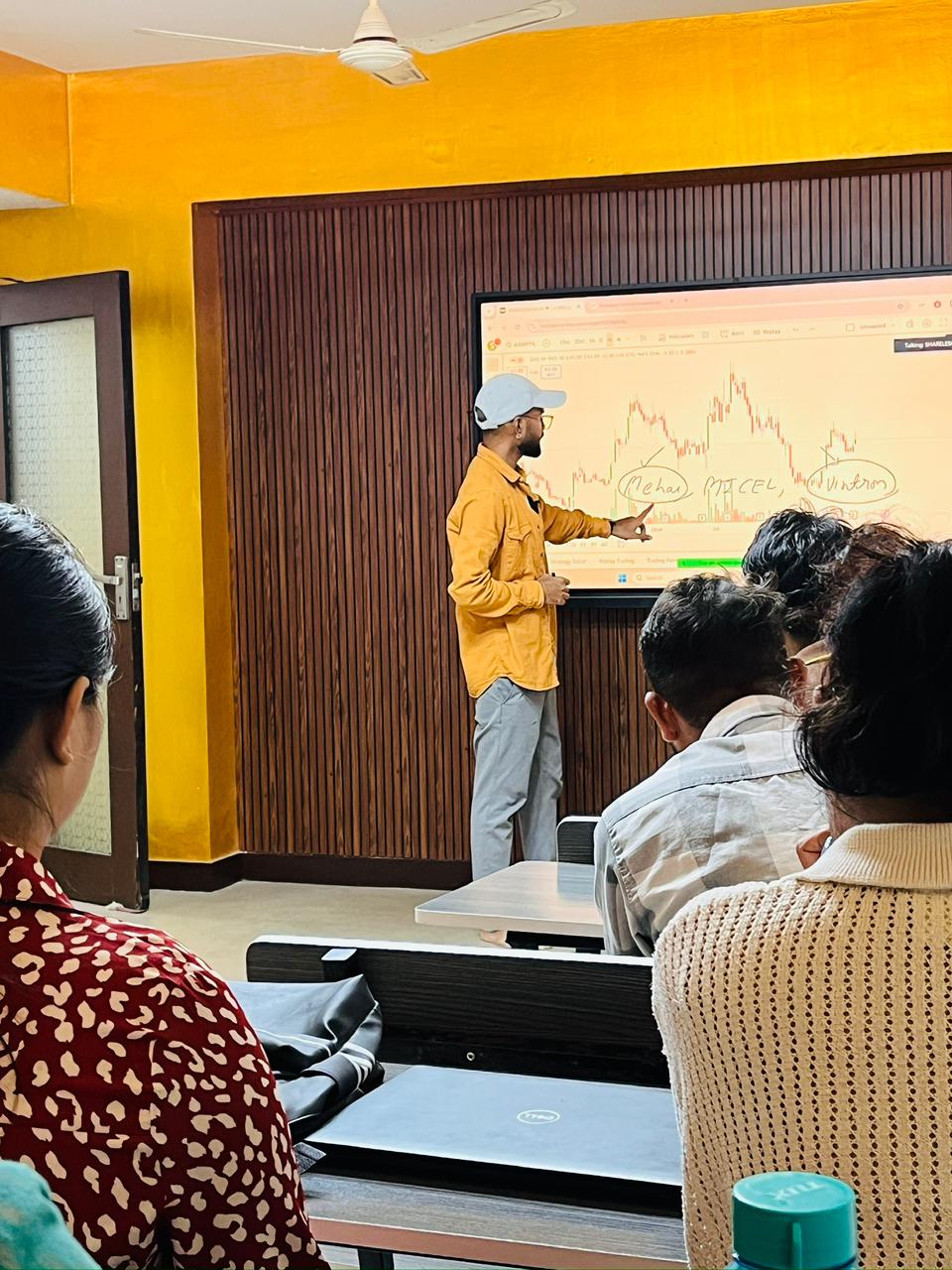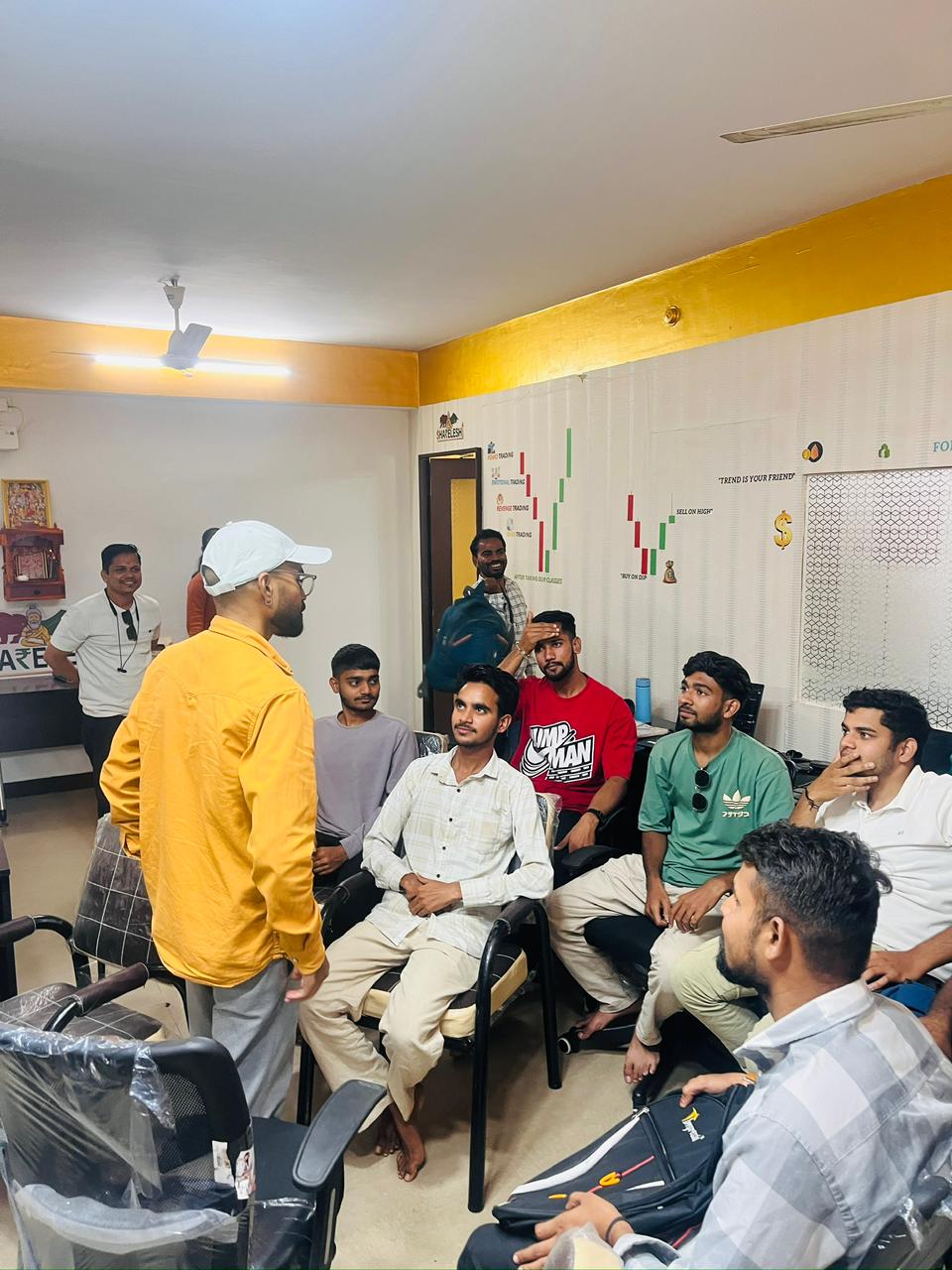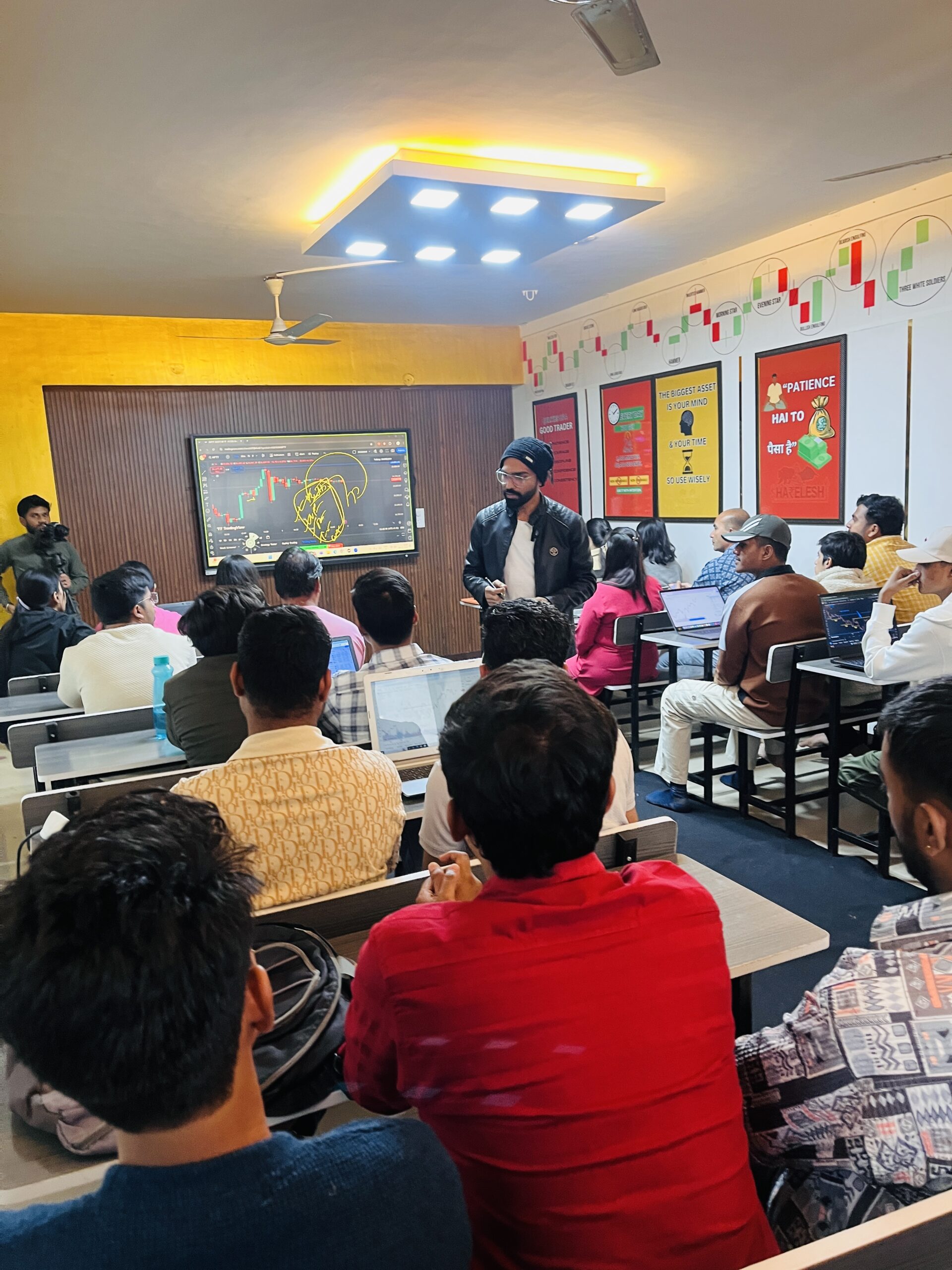

The Number That Should Shock Every Indian Trader
Every week at Sharelesh, new students walk through our doors. Some are young — college graduates who discovered options trading on Instagram. Some are salaried professionals who traded after office hours on their phones. Some are retired individuals who thought F&O would supplement their pension. Some even quit their jobs to trade options full time.
Almost all of them share one thing in common.
They lost money. Significant money. And most of them had absolutely no idea why.
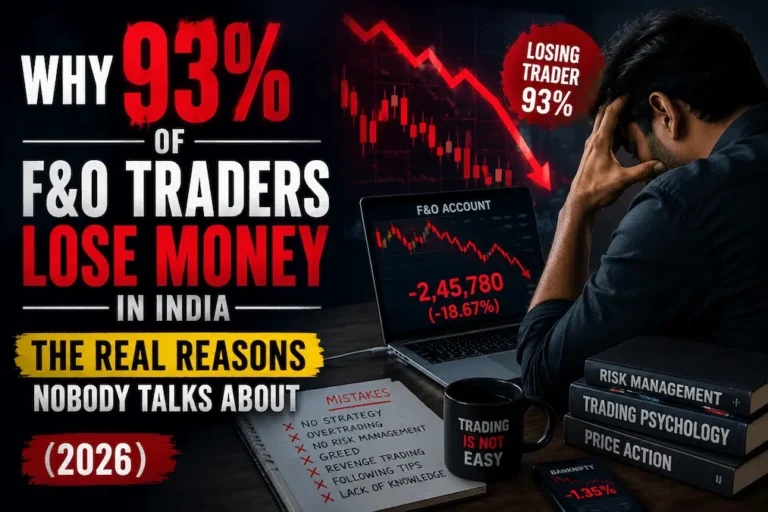
Here is the truth that trading apps, YouTube channels, and Telegram signal groups will never tell you: 93% of individual F&O traders in India lose money. That is not a rumour. That is not a scare tactic. That is the official finding of the Securities and Exchange Board of India — the government regulator that oversees every stock exchange in this country.
In my 17+ years as a trader and mentor at Sharelesh, I have seen every version of this story play out. The painful reality is this — most of these losses were completely avoidable. Not because the market is unfair. But because most traders enter F&O without truly understanding what they are actually doing.
This blog is my honest attempt to change that — one trader at a time.
What the SEBI Report Actually Says — Real Data Every Indian Trader Must Read
In September 2024, SEBI published an updated study on the profit and loss of individual traders in India’s equity F&O segment. The numbers were brutal — and every Indian who has ever traded or is thinking of trading options must read them carefully.
Here are the key facts directly from SEBI’s official findings:
- 93% of individual F&O traders lost money between FY22 and FY24. That is 1.13 crore unique traders who incurred a combined net loss of ₹1.81 lakh crore over just three years.
- Average loss per trader was ₹2 lakh over the three-year period. Additionally, each trader spent an average of ₹26,000 just on transaction fees in FY24 alone.
- Top 4 lakh loss-makers lost an average of ₹28 lakh each over three years. Furthermore, 91.5% of options traders lost money — compared to 60% in futures — making options the most dangerous segment for retail traders.
- 93% of traders below age 30 lost money in F&O in FY24. Even among senior citizens above 60, the loss percentage stood at 79%.
- 75% of retail traders remained active in F&O in the third year — even after losing money in the first two consecutive years.
- Average loss per trader rose to ₹1.1 lakh in FY25 — up 41% year on year — meaning losses are getting worse, not better, despite SEBI’s regulatory interventions.
Let these numbers settle in for a moment. Over 1 crore Indians — doctors, engineers, teachers, homemakers, and students — lost a combined ₹1.81 lakh crore in just three years. That is not market volatility. That is a structural problem. And at the heart of it are reasons that nobody in the mainstream is talking about honestly.
At Sharelesh, we talk about these reasons on Day 1 with every new student — because understanding why people lose is the foundation of learning how to win.
How Instagram and YouTube Are Creating a Generation of Losing F&O Traders
Before discussing the reasons traders lose, we need to address the pipeline feeding most of them into the F&O market — social media.
Open YouTube right now and search “options trading profit India.” Within seconds, you will find videos titled “₹10,000 to ₹1,00,000 in one day with options,” “I made ₹5 lakh in a single expiry,” and “How I quit trading in Bank Nifty.” These videos attract millions of views. They show real profit screenshots, real broker terminals, and real money being made. And they create a completely false picture of what options trading actually involves for the average person.
Here is what those videos never show you: the 47 losing trades before that one winner. The account blow-up that followed the viral video. The months of losses the creator never posts about. The fact that many of those screenshots are selectively chosen from one good day across an otherwise losing year.
At Sharelesh, I regularly meet students who tell me: “Sir, maine YouTube pe dekha tha — ₹5,000 mein Bank Nifty option khareed ke ₹50,000 banaye.” They saw it. It looked real. So they tried it. And within weeks, their capital was gone.
Social media does not create traders. It creates gamblers who believe they are traders. And the F&O market is perfectly designed to take money from gamblers and transfer it to disciplined, systematic professionals. Consequently, the first step at Sharelesh is always the same — unlearn what social media taught you before we teach you what actually works.

The 6 Real Reasons F&O Traders Lose Money in India
Reason 1 — No Education Before Entry
This is the most fundamental problem — and the most common one I see at Sharelesh every single week. Most Indian traders enter the F&O market without understanding what they are actually buying or selling.
An option is not a stock. When you buy a Nifty call option, you are not buying Nifty. You are buying the right to purchase Nifty at a specific price before a specific expiry date. That right has a cost — the premium — and that premium erodes every single day due to time decay, even if the market does not move at all.
Most beginners do not know this. They buy a ₹200 Bank Nifty call option because it looks cheap. The market moves in their direction by 50 points. But their option is worth less than what they paid — because time value decayed faster than the directional gain compensated. They were right about the direction. They still lost money. And they have absolutely no idea why.
This is precisely what happens when traders enter options without proper education. They cannot diagnose their own losses — so they cannot fix them. At Sharelesh, we ensure every student understands the mechanics of options completely before they place a single real trade.
Reason 2 — No Risk Management Whatsoever
At Sharelesh, I see four devastating risk management failures repeatedly among F&O beginners:
They never practise on demo before trading real F&O. Options trading requires understanding how premium moves relative to the underlying asset, how time decay accelerates near expiry, and how volatility affects pricing. None of this can be learned effectively while real money is at stake and emotions are running high.
They buy cheap OTM options on expiry day treating it as a lottery. A ₹5 out-of-the-money option on expiry day feels like a cheap bet. Buy 75 lots of Bank Nifty and the total outlay is ₹375. If it hits, you multiply. If it does not — which happens most of the time — you lose the entire premium. This is not trading. It is buying a lottery ticket with worse odds and calling it a strategy.
They have no stop loss and average down on losing positions. An option position going against you loses value exponentially as expiry approaches. Averaging down on a losing option does not reduce your average cost meaningfully — it simply increases total capital at risk in a position that is already proving you wrong.
They follow YouTube and Telegram tips blindly without understanding the trade. They receive a message — “Buy Bank Nifty 48000 CE at ₹150, target ₹400, stop loss ₹80” — and execute it without understanding why. When the trade fails, they have no framework to evaluate what went wrong. So they wait for the next tip and repeat the cycle.
Reason 3 — Transaction Costs Nobody Calculates
This is the silent killer of F&O accounts — and one of the most important findings in the SEBI report that almost nobody discusses honestly.
The cost of trading F&O amounts to 25% of total profit and loss. Brokerage accounts for 51% of transaction costs, exchanges take 20%, and the government collects the remaining 29%. Over three years, approximately 1 crore individual traders paid around ₹50,000 crore in transaction costs alone.
Think about what this means practically. A trader who actively buys and sells multiple contracts every week pays brokerage, STT, GST, exchange fees, and SEBI charges on every single trade — on both sides. An active trader making 20 trades per month can easily spend ₹3,000 to ₹5,000 per month just on transaction costs — without a single losing trade. Over a year, that is ₹36,000 to ₹60,000 in costs that must be recovered before seeing a single rupee of actual profit.
Most Indian F&O traders never calculate this. At Sharelesh, transaction cost awareness is a mandatory part of our curriculum — because you cannot build a profitable trading business without understanding your cost structure first.
Reason 4 — Overleveraging Without Understanding
F&O provides leverage that equity trading simply does not. A single Bank Nifty futures contract controls approximately ₹16–18 lakh worth of underlying with a margin of roughly ₹50,000–₹60,000. That is nearly 30:1 leverage — and most beginners have no real appreciation of what that means when the market moves against them.
Even in options buying, the leverage is dramatic. A small premium outlay can generate profits or losses equivalent to much larger capital movements. This leverage feels like a superpower when it works. However, it becomes a destruction machine when the market moves against an underprepared trader — which, for 93% of retail traders, it consistently does.
Reason 5 — No Trading Plan or System
At Sharelesh, I ask every new student a simple question: “Before your last trade, did you write down your entry reason, stop loss level, and profit target?” Almost none of them say yes.
Most Indian F&O traders make every decision in the moment — driven by price movement, gut feeling, a tip, or fear of missing out. They have no written plan. They have no rules for when to enter and when to stay out. They have no defined maximum loss for the day or week. And consequently, every trading session becomes an emotional experience rather than a business decision.
Professional traders — the 7% who consistently profit — operate from written systems with defined rules. They do not decide whether to trade based on how they feel that morning. They follow a process. That process is exactly what Sharelesh teaches every student from the very first session.
Reason 6 — Revenge Trading and Psychology Failure
SEBI’s own data reveals something deeply troubling: average losses increased from FY19 to FY22 despite traders having more market experience over time. This strongly suggests that revenge trading and loss escalation patterns worsen over time — not improve.
The pattern is always the same. A trader loses ₹5,000 on a morning trade. Instead of stopping, they immediately enter another trade to recover. That trade also loses. Now they are down ₹12,000. The desperation intensifies. Position sizes increase. Rules disappear. By 3:00 PM, what started as a ₹5,000 loss has become a ₹40,000 loss — driven entirely by emotion, not analysis.
At Sharelesh, every student who has come to us after losing money in F&O carries a version of this story. The market did not take their money in one move. Their trading psychology handed it over — trade by trade, decision by decision.
The Typical Indian F&O Beginner's Journey — How It Goes Wrong Step by Step
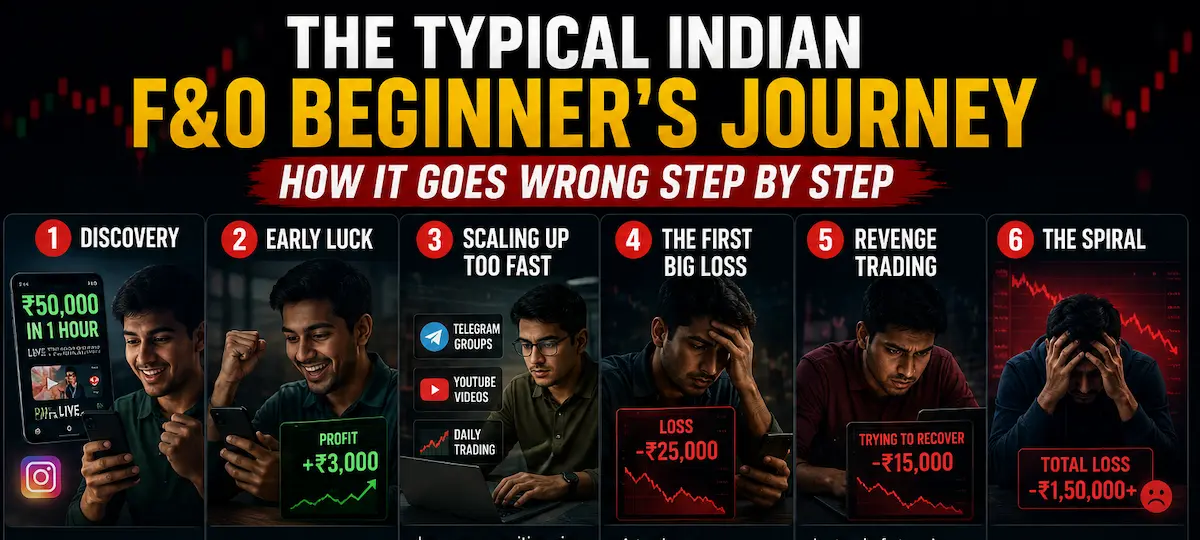
After teaching thousands of students at Sharelesh, I can describe the typical F&O loss journey with painful accuracy. It follows the same pattern almost every time.
Step 1 — Discovery. A young professional discovers options trading through a YouTube video or Instagram reel showing someone making ₹50,000 in an hour. It looks simple. It looks exciting. It looks like the solution to everything.
Step 2 — Early luck. They open a trading account, buy a cheap Bank Nifty option, and by luck — pure luck — it works. They make ₹3,000 in 20 minutes. This is the most dangerous moment of their entire trading journey. Early profit creates false confidence.
Step 3 — Scaling up too fast. Encouraged by early success, they increase their position size. They start trading daily. They join three Telegram signal groups. They watch YouTube videos every evening to find the next big trade. They feel like they are learning — but they are actually just gambling with growing amounts.
Step 4 — The first big loss. A trade goes catastrophically wrong. A position held over expiry day collapses. A signal from a Telegram group fails. They lose ₹20,000–₹30,000 in a single session. The shock is enormous.
Step 5 — Revenge trading. Instead of stopping and learning, they immediately try to recover. They trade bigger. They take more risk. They ignore every warning sign. Within weeks, their capital is severely depleted.
Step 6 — The spiral. Some traders stop here, having lost their initial capital. Others — as SEBI data confirms — add more money and keep going. They take personal loans. They use savings meant for other purposes. The losses compound. The psychological damage deepens.
Step 7 — Arrival at Sharelesh. Eventually, many of them find us. Some have lost ₹50,000. Some have lost ₹5,00,000. Some, like the ambulance service owner whose story I shared in our trading psychology blog, have lost life-changing amounts. They come to Sharelesh not just to learn trading — but to understand what went wrong and whether there is a way forward.
There always is. But it requires starting from the right foundation — not from where social media told them to start.
Why 75% of Losing Traders Keep Coming Back — The Psychology of Loss
One of the most striking findings in the SEBI report is that 75% of retail F&O traders kept trading in the third year even after losing money in the first two consecutive years. This is not stubbornness. It is a deeply human psychological pattern.
Psychologists call it the sunk cost fallacy — the feeling that because you have already lost so much, you cannot walk away. Walking away means accepting that the losses are real and permanent. Continuing to trade keeps alive the hope that recovery is just one good trade away.
Additionally, the occasional wins — even small ones — provide powerful psychological reinforcement. The brain remembers wins disproportionately and forgets losses more easily. A trader who loses 8 times and wins twice will often remember the two wins and believe their strategy is fundamentally sound.
At Sharelesh, we address this psychology directly. Accepting a loss is not failure. It is the first step towards correct learning. The traders who improve fastest are not those who never lost money — they are those who stopped letting past losses drive current decisions.
What the Profitable 7% Do Differently — The Real Difference
While 93% of F&O traders lose, 7% are consistently profitable. At Sharelesh, we study what this minority does differently — because those habits are exactly what we teach.
They treat trading as a business, not a gamble. Every trade has a written plan. Every session has a defined maximum loss. Every week has a performance review. They track everything — not just profit and loss, but their emotional state, their decision quality, and their execution discipline.
They understand what they are trading before they trade it. They know how theta decay works. They understand how implied volatility affects option pricing. They know the difference between buying options and selling options and when each approach is appropriate.
They use small, defined risk on every trade. They never risk more than 1–2% of total capital on a single F&O position. Consequently, even a losing streak of 10 consecutive trades does not destroy their account — it costs them 10–20% of capital, which is entirely recoverable.
They are profitable in equity before they ever touch options. This is the single most important habit — and the one that Sharelesh teaches as the foundation of our entire curriculum. More on this below.
They have mentorship and structured learning. The SEBI data shows that individual algorithmic traders — those with rules-based systems — performed better than purely discretionary traders. Professional guidance and structured learning create the systems that protect capital while building skills.
The Sharelesh Philosophy — The Key Insight That Changes Everything About F&O
After 17+ years of teaching thousands of students at Sharelesh, I have developed one core philosophy about options trading that is completely different from what you will hear anywhere else. And this philosophy has changed the trajectory of hundreds of our students’ trading careers.
Here it is: Before you ever touch the options market, first become consistently profitable in equity trading.
This is not just advice. This is the foundation of everything we teach at Sharelesh.
The options market — the F&O segment — is a derivative market. It is derived from the spot price of the underlying asset, which is equity shares. Options do not exist independently. They are built on top of equity. Therefore, if you cannot read equity price movements correctly and trade them profitably, you have absolutely no business trading the derivative of something you do not yet understand.
But there is an even more powerful reason for this approach — and it is psychological, not technical.
When you first become profitable in equity trading, you generate trading profits. Real profits, earned from the market through skill and discipline. Now — and only now — when you use a portion of those profits to trade options, something remarkable happens to your psychology. You are no longer trading with your salary. You are not trading with your savings. You are not trading with money earmarked for your family’s future. You are trading with money the market itself gave you.
At that point, your emotions change completely. Fear diminishes. Greed becomes manageable. The desperate need to recover losses disappears — because you are not risking anything that you cannot afford to lose. Your decision-making improves instantly and dramatically.
This is the key that most people never understand about options trading. And it is the exact reason why so many retail traders lose — they start with their hard-earned savings in the most complex, most leveraged, most time-sensitive financial instrument available, with no foundational skills and maximum emotional pressure.
At Sharelesh, we reverse this entirely. We build the foundation first. We create profitable equity traders first. And then — when the student is ready, skilled, and emotionally prepared — we introduce them to the world of options with a completely different mindset.
That single shift in approach is the difference between being in the 93% and being in the 7%.
The ‘Equity First, Options Later’ philosophy is Sharelesh’s original teaching methodology, developed over 17+ years of market experience and student mentorship.
How to Move From the 93% to the 7% — The Sharelesh Action Plan
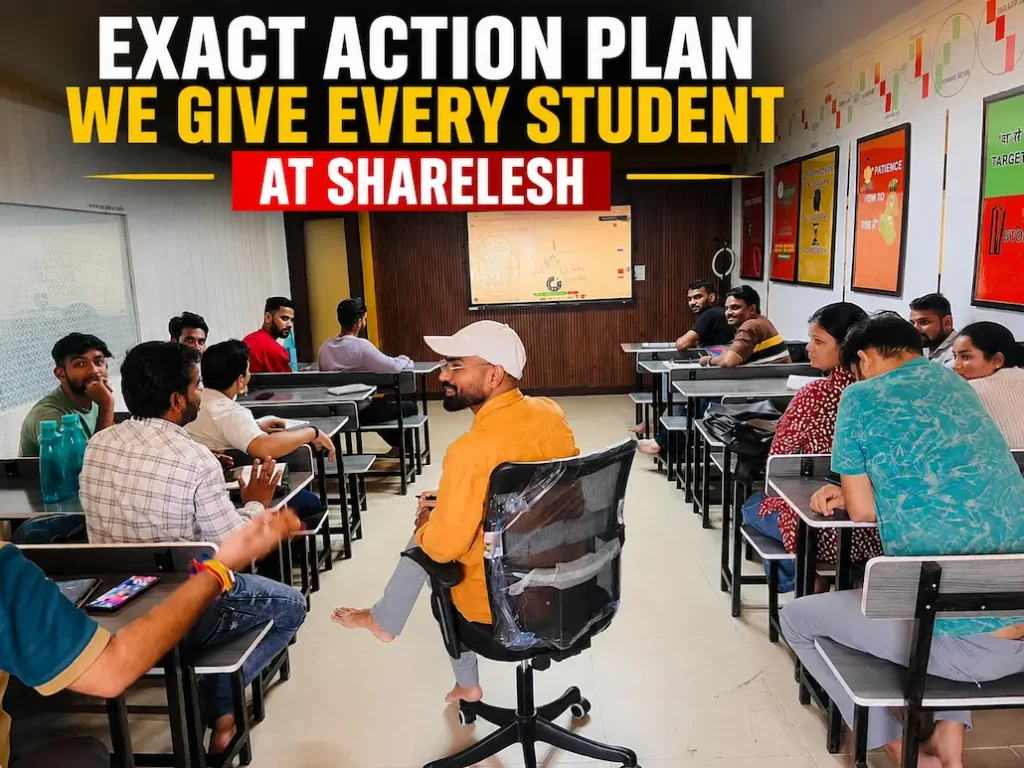
If you have lost money in F&O — or if you are considering entering F&O for the first time — here is the exact action plan we give every student at Sharelesh.
Step 1 — Stop trading F&O immediately if you are losing. This is non-negotiable. You cannot learn while bleeding capital. Step away, assess your losses honestly, and commit to building the right foundation before returning.
Step 2 — Learn equity trading first. Start with understanding how equity markets work — chart reading, support and resistance, candlestick patterns, basic technical analysis. Practice on a demo account for a minimum of three months. Do not move forward until you are consistently making correct decisions in equity.
Step 3 — Become profitable in equity on a live account. Move to a small live equity account. Trade with discipline. Apply risk management — 1% rule, stop losses, daily loss limits. Build a track record of consistent, profitable equity trading over three to six months.
Step 4 — Only then approach options — with the right education. Once you have equity profits and genuine market understanding, approach options with structured learning. Understand theta decay, implied volatility, the Greeks, and options strategies before placing a single real options trade. At Sharelesh, this is an entire dedicated module in our curriculum.
Step 5 — Use only market profits to trade options initially. When you begin options trading, use only the profits you have generated from equity trading — not your original capital, not your savings. This single rule transforms your psychology and your decision-making overnight.
Step 6 — Track everything in a trading journal. Record every trade — entry, exit, reason, emotional state, result. Review weekly. Patterns in your behavior will become visible within one month. Fix the patterns before they fix your account.
Frequently Asked Questions About F&O Trading Losses in India
Q: Why do 93% of F&O traders lose money in India?
Because they start at the wrong place. Options is a derivative market — it is built on top of equity shares. If you cannot trade equity profitably first, you are not ready for options.
Q: Is F&O trading suitable for beginners?
No. F&O — particularly options — is not suitable for beginners. Options require understanding of time decay, volatility, and leverage that takes months of structured learning to develop.
Q: How much money do F&O traders lose on average in India?
According to SEBI data, the average individual F&O trader lost ₹2 lakh over the FY22–FY24 period. Additionally, the top 4 lakh loss-makers lost an average of ₹28 lakh each. In FY25, the average loss per trader rose further to ₹1.1 lakh — up 41% year on year.
Q: What should I do if I have already lost money in F&O?
Stop trading immediately — trying to recover losses with more trading only makes things worse. Come back to basics, learn equity trading first, and build the right foundation. At Sharelesh, we have helped hundreds of students rebuild their trading career after F&O losses — and we can help you too.
Q: How can Sharelesh help me become a profitable trader?
At Sharelesh, we teach a complete, structured curriculum that starts with equity market fundamentals and builds to advanced options trading — in the correct sequence.
The Market Will Always Be There — But Your Capital Will Not
The F&O market will be open tomorrow, and the day after, and the day after that. There is no urgency. There is no trade you must take today that will not appear again next week.
What is finite, however, is your capital. And once it is gone — whether to bad trades, transaction costs, or revenge trading — rebuilding it takes far longer than it took to lose it.
The SEBI data on why F&O traders lose money is not a warning to avoid the market entirely. It is a blueprint. It tells you exactly what behaviours destroy capital — and implicitly points to what actually works. The question is whether you are willing to do the unglamorous work of building a real foundation before you risk real money.
At Sharelesh, that foundation is what we build — one student at a time.
None of that happened because of luck. None of it happened because of a YouTube tip or a Telegram signal. It happened because of structured learning, disciplined risk management, and — above all — the right foundational approach.
The 7% is not a club you are born into. It is a club you build your way into — one correct decision at a time.
“© 2026 Sharelesh. All rights reserved. The trading philosophy, teaching methodology, and content on this blog are the original intellectual property of Sharelesh Institute. Unauthorized reproduction is prohibited.”