The Real Reasons Beginners Lose Money in Trading And How to Avoid Them
Every year, thousands of Indians open a demat account with big dreams. They have seen the reels. They have watched the YouTube videos. They have heard stories of people turning Rs50,000 into Rs5 lakh in months. And so they jump in excited, hopeful, and completely unprepared.
Within six months, most of them are gone.
This is not a small problem. SEBI’s own data confirms that over 95% of active traders in India lose money. More than two-thirds of new traders do not continue trading past their first year, and over 90% leave the market within the first three years. They do not leave because the market is unfair. They leave because nobody told them the truth before they started.
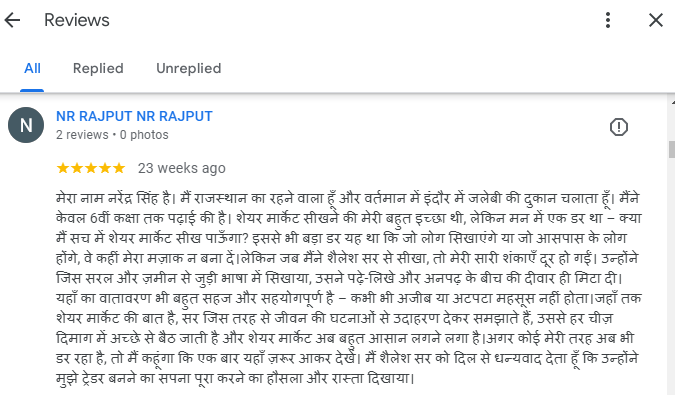
I have been trading since 2008. Over the last 17+ years, I have trained thousands of students from working professionals to a 6th class passout who now successfully trades while running his jalebi shop in Indore. The one thing every losing beginner has in common is not bad luck. It is a specific, repeatable set of mistakes that nobody warned them about.
This blog is that warning.
Mistake #1: Opening a Demat Account Before Opening a Book
This is the mistake that makes all other mistakes possible.
Most beginners treat opening a demat account as Step 1 of their stock market journey. It is not. It is actually one of the last steps and opening it too early is the single biggest reason beginners lose money.
Think about it this way. You would not sit behind the wheel of a car before learning traffic rules, understanding how gears work, and practicing in a safe environment. Yet every day, thousands of beginners deposit Rs.10,000 or Rs.20,000 into a trading account with zero understanding of how markets move, what a candlestick means, or what a stop loss even is.
The result is predictable. They place random trades based on gut feeling or someone else’s advice. When prices fall, they panic. When prices rise, they get greedy. Within weeks, the capital is gone and they conclude that the stock market is not for them.
The correct sequence is this: Learn first. Practice on paper. Then trade with real money.
In my classes, no student is asked to open a live trading account until they have completed the foundational modules, understand basic chart reading, and have practiced for at least 30 days on a simulator. This one change in sequence dramatically improves outcomes.
Mistake #2: Trusting Instagram Traders and Telegram Tips
This mistake is costing Indian beginners crores of rupees every single year and it is getting worse, not better.
Open Instagram today and you will find hundreds of accounts showing screenshots of Rs.1 lakh profits made in a single day. Luxury cars. Foreign trips. “I made Rs.3 lakh from home in 2 hours.” The comments are full of people asking “sir, which course?” or “bhai, which stock?”
Here is the truth: most of these accounts are either fake, manipulated, or showing you the one good day out of thirty bad ones.
SEBI has repeatedly warned about unregistered advisors operating on Telegram, WhatsApp, and social media platforms. These so-called tipsters have no accountability. When their tips fail and they fail far more often than they succeed, you are the one who loses the money. They simply move on to the next follower.
Free tips are not free. You pay for them with your capital.
The only tips worth following are your own built on real knowledge, real analysis, and a clear trading plan. That is what structured education builds. No shortcut on Telegram will ever replace that.
Mistake #3: Starting with Intraday or F&O Trading
If Mistake #1 is the most common, Mistake #3 is the most expensive.
Intraday trading and F&O (Futures and Options) are the most advanced segments of the stock market. They require deep technical knowledge, split-second decision making, and iron emotional discipline. They are not beginner territory. Yet almost every new trader in India starts here because these are the segments that promise the fastest returns.
Data shows that over 95% of Indian traders lose money in intraday markets, and a vast majority stop trading within one to three years.The reason is simple: leverage amplifies both gains and losses. In F&O, you can lose more than you invested. For a beginner with no risk management framework, this is catastrophic.
The right starting point is equity delivery trading buying shares and holding them for days, weeks, or months. This segment is forgiving. It gives you time to think, learn from your decisions, and build confidence without the brutal time pressure of intraday trading.
Spend your first 12 months in equity delivery. Learn how markets behave across different conditions rallies, corrections, sideways movements. Only after you are consistently profitable in delivery should you explore faster segments.
Mistake #4: Trading Without a Stop Loss
A stop loss is not optional. It is not a suggestion. It is the single most important risk management tool available to every trader and most beginners ignore it completely.
Here is what happens without a stop loss. You buy a stock at Rs.500 expecting it to go to Rs.550. Instead, it falls to Rs.470. You tell yourself it will recover. It falls to Rs.440. Now you are too deep in a loss to exit. It falls to Rs.390. You have now lost Rs.110 per share on a trade where you were only looking to make Rs.50.
This pattern plays out in thousands of trading accounts every single day across India.
A stop loss forces discipline. It says: “If this trade goes wrong by X amount, I exit. No questions. No hoping. No waiting.” A stop loss of 2–3% on a trade means your maximum loss on any single trade is controlled and defined. Over hundreds of trades, this discipline is the difference between a blown account and a growing one.
Every trade you place must have a stop loss set before you enter. Not after. Before.
Mistake #5: Letting Emotions Make Your Decisions
The stock market is the only place in the world where people buy more when prices are rising (greed) and sell everything when prices are falling (fear) the exact opposite of sensible behavior.
This is not stupidity. It is human psychology. And it destroys more trading accounts than any bad tip or wrong analysis ever could.
Fear makes you exit a good trade too early, locking in tiny profits while leaving large gains on the table. Greed makes you hold a winning trade too long, watching it reverse and turn into a loss. Revenge trading entering a new trade immediately after a loss to “recover” the money is one of the most destructive patterns I have seen in my 20 years of experience. It turns a rs5,000 loss into a rs20,000 loss in a single session.
The solution is not to eliminate emotions that is impossible. The solution is to have a written trading plan that you follow regardless of how you feel. Entry point, exit point, stop loss, position size all decided before you enter the trade, when your mind is calm and rational.
This is why trading psychology is a dedicated module in our curriculum. Technical knowledge without emotional discipline is a half-built house. It will not stand when the storm comes.
Mistake #6: The Overconfidence Trap After Your First Win
Nobody warns beginners about this one and it is one of the most dangerous phases of a new trader’s journey.
Here is how it plays out. A beginner makes a profit on their first or second trade. Maybe they turn rs10,000 into rs14,000 in a week. Suddenly, the market feels easy. They increase their position size. They skip their own rules. They start taking trades they have not properly analyzed because “their gut is working.”
What follows is almost always a large, painful loss that wipes out not just the recent gain but often a significant portion of their original capital.
The first few wins are the most dangerous period for any new trader. The market has not rewarded your skill it has rewarded your timing. And timing luck runs out. Real skill is what you need to replace it.
The antidote to overconfidence is process. Follow your checklist on every trade. Maintain a trading journal. Review your trades weekly. When you see yourself skipping steps, that is a red flag not a sign of mastery.
Mistake #7: The "I'll Learn While Trading" Myth
This is perhaps the most expensive belief a beginner can carry into the market.
The idea sounds logical: “Why waste time reading books when I can learn by doing?” The problem is that in the stock market, the cost of learning by doing is real money. Every mistake has a price tag. And without any foundational framework, the same mistakes get repeated at higher and higher cost.
I have met students who spent two years trading without education, losing Rs3–5 lakh in what they called their “learning phase.” When they finally joined a structured course, they learned in 60 days what two years of random trading could not teach them.
The market is not a classroom that rewards curiosity. It is a marketplace that punishes ignorance swiftly and without mercy. The right approach is to build your knowledge base first on someone else’s time and experience and then enter the market with clarity and a tested strategy.

The One Thing That Separates Losing Traders from Profitable Ones
After 17 years of trading and working with thousand’s of students, I can tell you with complete confidence that the single biggest difference between traders who lose and traders who consistently profit is not intelligence. It is not capital. It is not even the strategy they use.
It is structured learning under an experienced mentor.
When you learn from someone who has already made the mistakes, navigated multiple market cycles bull runs, crashes, sideways markets and built a proven methodology, you compress years of painful self-education into months of focused progress.
One of our students a 6th class passout who runs a jalebi shop is today trading profitably on his own. Not because he was particularly gifted. But because he followed a structured curriculum, worked on his psychology, practiced risk management religiously, and had a mentor to course-correct him when he went wrong.
That is what real trading education does. It does not give you tips. It gives you the ability to generate your own decisions consistently and confidently.
Our classes cover everything from foundational market concepts to a proprietary candlestick pattern framework built over two decades of live trading. We work specifically on risk management and trading psychology because those two pillars alone determine whether a trader survives long enough to become profitable.
We offer online and offline classes, free lifetime mentorship, and unlimited access to all sessions. Because the market keeps evolving, and your education should too.
Conclusion — Your Next Step
The stock market is not a lottery. It is not a casino. And it is absolutely not a place where tips and luck build lasting wealth.
It is a skill. And like every skill whether it is surgery, cricket, or cooking it rewards those who learn it properly and punishes those who try to shortcut their way through it.
The 5% of traders who consistently make money are not smarter than you. They are simply better prepared. They made the decision at some point to stop guessing and start learning.
That decision is available to you right now.
“First understand the market. Then start trading on your own. Financial independence is not a dream – it is a destination. And the right education is the fastest route to get there.”
Read Next : Stock Market Basics for Beginners in India – The Complete 2026 Guide
JOIN FREE DEMO CLASS
Disclaimer: The content shared on this blog is purely for educational and informational purposes related to the stock market and trading. We do not provide any financial advice, investment recommendations, or profit guarantees. Trading and investing involve market risk.