
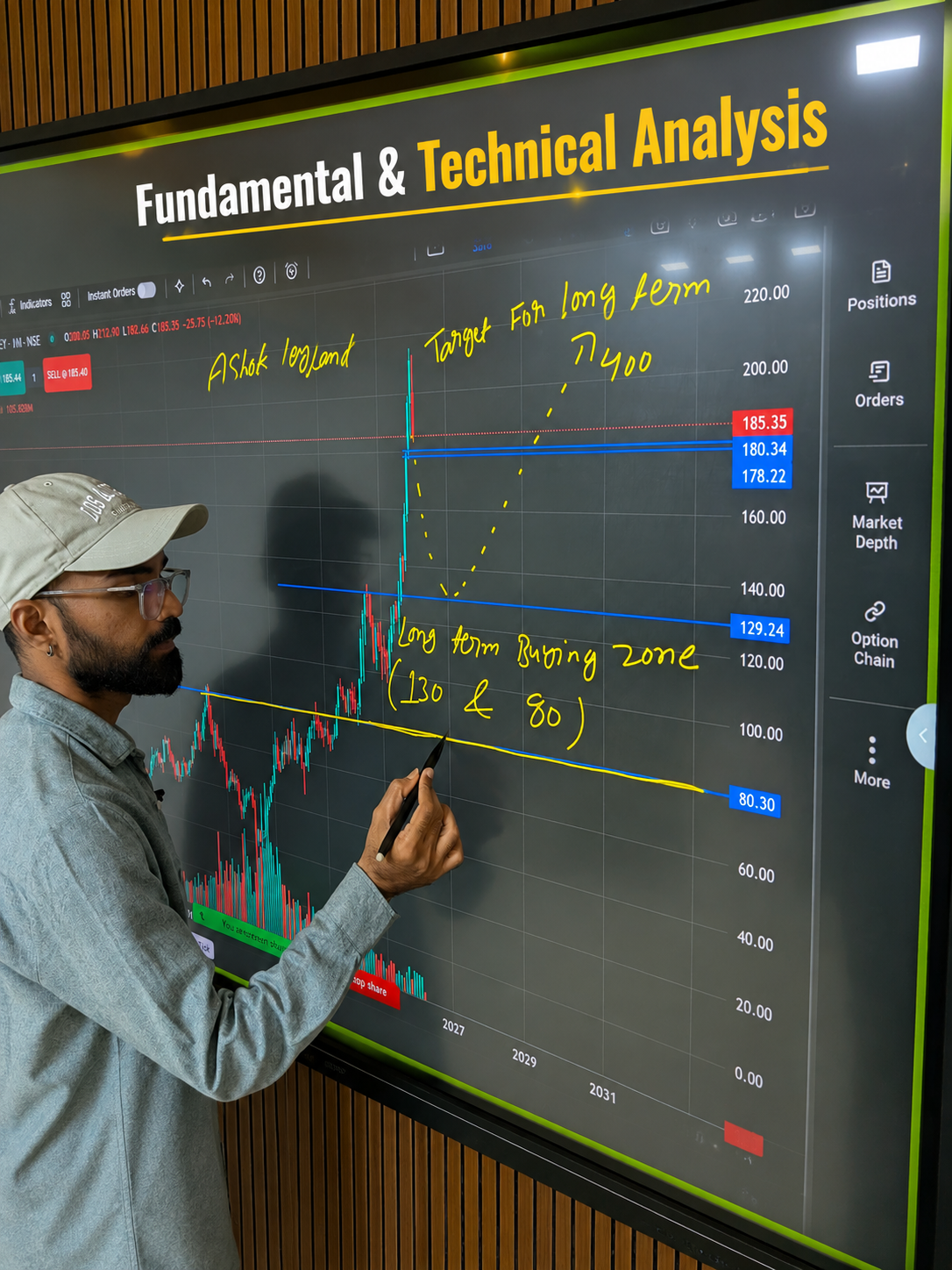
Two Skills Every Indian Trader and Investor Must Know
Every week at Sharelesh Trading Academy, new students walk into our classroom with confidence. They know what a stop-loss is, have heard about support and resistance, and many have already placed a few options trades. Most believe this is enough to trade the stock market successfully.
Within the first session, they realize something surprising their foundation isn’t as strong as they thought.
They know the terminology but not the concepts behind it. They understand the tools but not when or why to use them. They can identify a candlestick pattern but struggle to explain why a stock is moving or whether the move is likely to continue.
This gap between surface-level knowledge and real market understanding is where most Indian traders lose money.
At the heart of this gap are two essential skills: Fundamental Analysis and Technical Analysis.
These aren’t just trading buzzwords. They are the two pillars of successful investing and trading. Fundamental Analysis helps you understand what to buy by evaluating a company’s financial strength, business quality, and long-term potential. Technical Analysis helps you decide when to buy or sell by studying price action, trends, volume, and market behaviour.
Without these skills, traders often depend on tips, Telegram channels, social media influencers, or gut feelings. With them, every trading decision is based on logic, data, probability, and a structured process.
In my 17+ years of studying and teaching the markets at Sharelesh Trading Academy, I’ve noticed one common pattern: the students who become consistently profitable don’t rely on shortcuts. They first build a strong foundation in Fundamental Analysis, Technical Analysis, Risk Management, and Trading Psychology, then apply these principles with discipline.
In this guide, you’ll learn the difference between Fundamental Analysis and Technical Analysis, when to use each one, which trading style they suit best, and why mastering both can transform the way you approach the stock market.
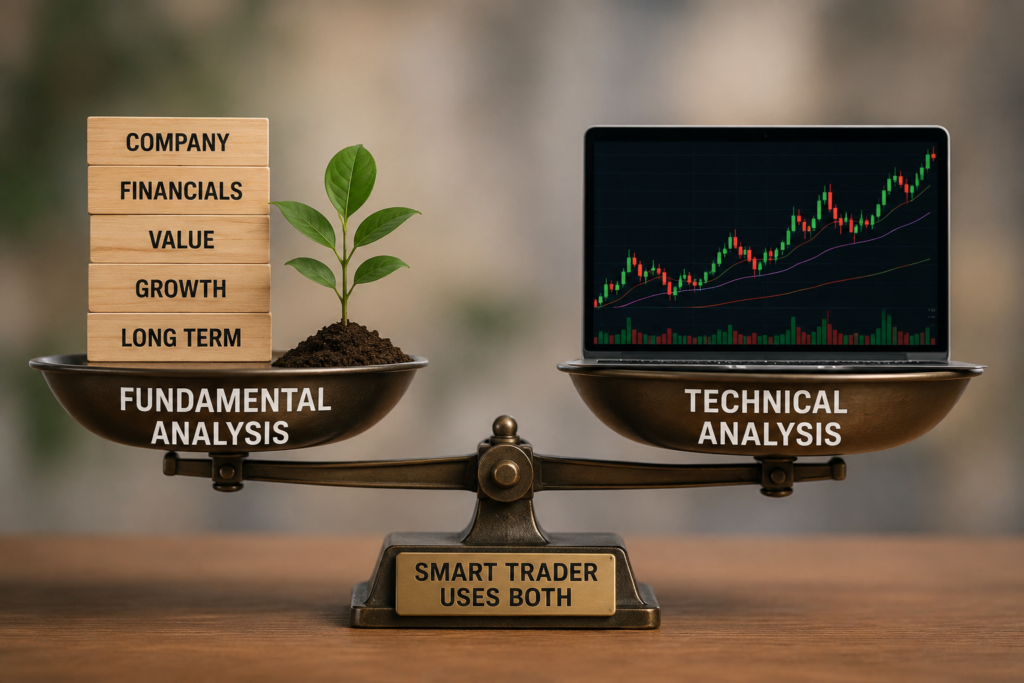
What is Fundamental Analysis? Simple Definition with Example
Fundamental analysis is the method of evaluating a company’s true value by studying its financial health, business model, management quality, and overall economic environment.
In simple words – fundamental analysis answers the question: Is this company worth investing in?
It does not care about what the stock price did yesterday. It does not look at charts. Instead, it digs into the business behind the stock. How much revenue does this company generate? Is it profitable? Does it carry too much debt? Is the management trustworthy? Is the industry it operates in growing or shrinking?
Simple Indian Example:
Imagine you want to buy a shop in your city. Before paying the price, what do you check?
You check how much monthly income the shop generates. You check whether the shop has any outstanding loans. You check whether the location is good and whether customers visit regularly. You check the reputation of the owner who is selling it to you. And you check whether similar shops in the area are selling for more or less.
All of these checks – before you decide whether the shop is worth buying at the asking price is exactly what fundamental analysis does for a stock. Instead of a shop, you are evaluating a company. Instead of monthly income, you study quarterly revenue and profit. Instead of loans, you study the debt on the balance sheet.
At Sharelesh, we teach students this first: before you put money into any company’s stock, understand the business behind it. Know how it earns money. Know whether it earns more than it spends. Know whether the people running it are trustworthy. Without this understanding, you are not investing — you are guessing.
What is Technical Analysis? Simple Definition with Indian Example
Technical analysis is the method of predicting future price movements by studying historical price charts, trading volume, and market patterns.
In simple words – technical analysis answers the question: When is the right time to buy or sell?
It does not care about the company’s balance sheet. It does not study profits or revenue. Instead, it studies price how it has moved in the past, what patterns it has formed, where buyers and sellers have historically shown strong interest, and what the current momentum of price movement suggests about the near future.
Simple Indian Example:
Imagine you want to buy mangoes. You already know the mango farm is excellent — the quality is good, the reputation is strong, and the business is healthy. But mangoes are expensive in March and cheap in June. Technical analysis is what tells you — based on how mango prices have behaved in past years, when to buy at the best price.
You are not questioning whether to buy mangoes. That decision is already made. You are only deciding when to enter the market to get the best price.
This is exactly what technical analysis does for stocks. You use charts, candlestick patterns, support and resistance levels, and momentum indicators to identify the best timing for your entry and exit, once you have already decided, through fundamental analysis, that the company is worth investing in.
The Mango Market Analogy - Understanding Both Analyses in One Story
At Sharelesh, here is the single analogy that makes both analyses permanently clear for every student:
You visit a mango market. You want to buy mangoes to resell at a profit.
Step 1 — Fundamental Analysis: You inspect every mango stall. You taste the mangoes, check their freshness, ask about the farm they came from, and compare the quality across different vendors. After careful evaluation, you identify one stall whose mangoes are clearly superior best quality, best farm, best reputation. You decide this is the stall I want to buy from.
Step 2 — Technical Analysis: Now you watch the market. The stall owner’s price fluctuates throughout the day. In the morning, prices are high because demand is strong. By afternoon, prices drop as the crowd thins. You notice that every day around 3 PM, prices hit their lowest point before rising again toward evening.
So you wait. At 3 PM, you buy at the day’s lowest price. You sell in the evening at the peak.
In this story:
- Choosing the RIGHT stall = Fundamental Analysis (finding what is worth buying)
- Choosing the RIGHT TIME to buy = Technical Analysis (finding when to buy it)
Fundamental analysis finds the right company. Technical analysis finds the right entry point.
Both together – used in the correct sequence – produce the most confident, complete trading and investing decisions. This is exactly what Sharelesh teaches every student who wants to move beyond surface-level market knowledge.
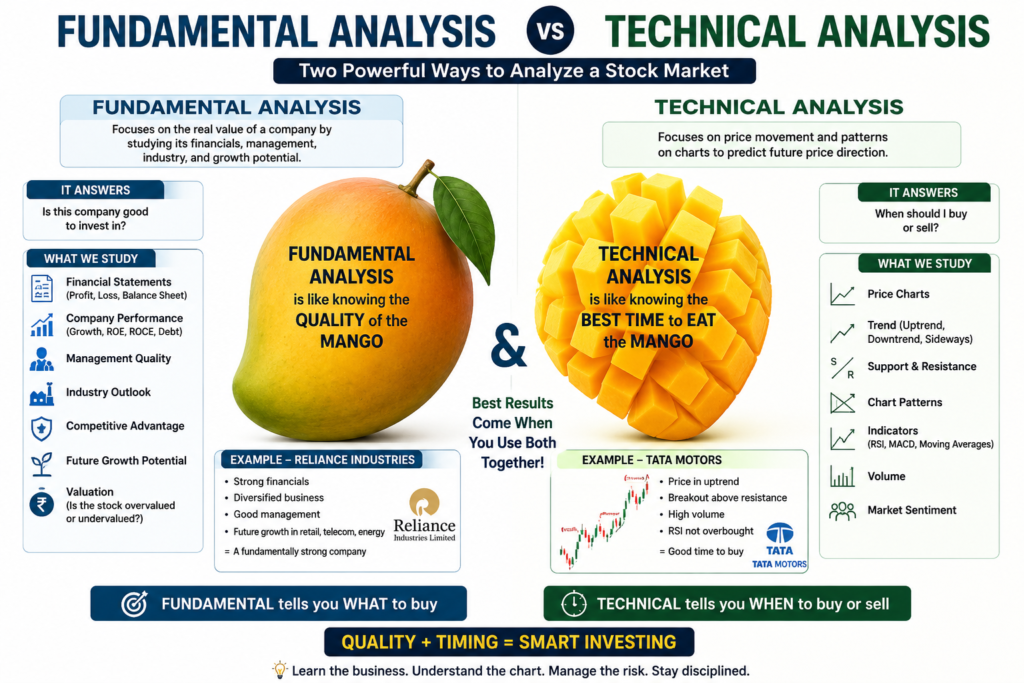
Fundamental vs Technical Analysis - Complete Comparison Table
|
Parameter
|
Fundamental Analysis
|
Technical Analysis
|
|---|---|---|
|
Main Question
|
Is this company worth buying?
|
When is the right time to buy or sell?
|
|
What it Studies
|
Financial statements, business model, management
|
Price charts, volume, patterns, indicators
|
|
Time Horizon
|
Long term — months to years
|
Short term — minutes to weeks
|
|
Best For
|
Long term investors, multibagger hunters
|
Traders, intraday, swing traders
|
|
Key Tools
|
PE ratio, ROE, balance sheet, annual report
|
Candlesticks, support/resistance, RSI, MACD
|
|
Data Source
|
Company filings, quarterly results, annual reports
|
Price and volume data on charts
|
|
Decision Output
|
Buy or avoid this company
|
Buy now, wait, or exit
|
|
Ignores
|
Short term price fluctuations
|
Company financials and business quality
|
|
Weakness
|
Cannot tell you when to enter
|
Cannot tell you if the company is fundamentally strong
|
|
Sharelesh Recommendation
|
Learn for investors + multibagger research
|
Learn first for traders
|
Key Tools of Both Analyses - Practical Guide for Indian Beginners
Fundamental Analysis Tools
PE Ratio (Price to Earnings) The PE ratio tells you how much the market is paying for every rs1 of company earnings. A PE of 20 means the market pays rs20 for every rs1 of annual profit. Comparing a company’s PE to its sector average tells you whether it is overvalued or undervalued. However and this is what most beginners miss a low PE does not automatically mean a good buy. Understanding the business behind the PE is essential.
ROE (Return on Equity) ROE measures how efficiently a company generates profit from shareholders’ money. A consistently high ROE above 20% – over multiple years is one of the strongest signals of a quality business. At Sharelesh, ROE consistency is one of the first things we check in any multibagger candidate.
Debt to Equity Ratio This ratio tells you how much debt the company carries relative to its equity. A ratio below 0.5 is generally safe for non-financial companies. High debt means the company pays large interest costs – which eat into profits and create risk during economic downturns.
Annual Report The annual report is the most underused research tool among Indian retail investors. It contains the complete financial picture of a company revenue, profit, debt, management discussion, future plans, and risk factors. At Sharelesh, reading annual reports before investing in any company is non-negotiable. It is the primary source of ground truth about any business.
Screener.in For Indian stocks, Screener.in is one of the best free fundamental research platforms available. It aggregates all financial data for NSE and BSE listed companies PE, ROE, revenue growth, profit margins, debt levels in one clean interface. Every Sharelesh student who learns fundamental analysis uses Screener.in as their primary research tool.
Technical Analysis Tools
Candlestick Patterns Candlesticks are the language of price action. Each candle shows four pieces of information open, high, low, and close for a specific time period. Patterns formed by candlesticks – Doji, Hammer, Engulfing, Morning Star give traders signals about potential price direction changes. At Sharelesh, candlestick pattern recognition is the first technical skill every student learns.
Support and Resistance Support is a price level where buying interest has historically been strong enough to stop a price from falling further. Resistance is a level where selling pressure has historically stopped prices from rising further. These levels are the foundation of all technical analysis and the most consistently useful tool across all markets and timeframes.
RSI (Relative Strength Index) RSI is a momentum indicator that measures whether a stock is overbought or oversold. An RSI above 70 suggests the stock may be overbought potentially due for a pullback. Below 30 suggests it may be oversold potentially due for a bounce. RSI is most useful when confirmed by price action and candlestick patterns.
TradingView For technical chart analysis of Indian stocks, TradingView is the most comprehensive and beginner-friendly platform available. It provides real-time Nifty, Bank Nifty, and individual stock charts with all technical indicators built in. At Sharelesh, TradingView is the primary technical analysis platform we teach on.
Real Indian Stock Example — Same Stock Through Both Lenses
Let us take a hypothetical Indian company a strong mid-cap manufacturing business and look at it through both fundamental and technical lenses simultaneously. This is exactly how Sharelesh teaches students to research stocks.
Fundamental Analysis View:
- Revenue growing 20%+ for past 3 consecutive years
- ROE consistently above 22%
- Debt to equity ratio of 0.3 – very low
- Promoter holding stable at 58%
- Operating in a sector with strong government tailwind
- PE ratio at 18 – below sector average of 24
Fundamental conclusion: This is a fundamentally strong company trading below its sector valuation. It qualifies as a potential buy but timing the entry is the next question.
Technical Analysis View:
- Stock has been in a clear uptrend on the weekly chart for 8 months
- Currently pulled back to a strong support level that has held three times previously
- RSI has cooled from 72 to 48 – no longer overbought
- A bullish hammer candlestick formed at the support level in the last session
- Volume on the pullback is low — suggesting sellers are not aggressive
Technical conclusion: The stock is at a high-probability entry zone. The pullback to support with decreasing volume and a bullish reversal candle suggests a potential bounce from here.
Combined Sharelesh Decision: Fundamental analysis identified a strong company worth owning. Technical analysis identified the right moment to enter — at support, after a healthy pullback, with bullish signals. Together, both analyses produce a high-confidence decision that neither could produce alone.
This is the complete picture. This is what Sharelesh teaches.
Fundamental Analysis Helps You Choose the Right Stock. Technical Analysis Helps You Enter at the Right Time.
At Sharelesh Trading Academy, we teach both because successful trading isn’t just about finding a good company – it’s about buying it at the right price with proper risk management and trading psychology.
This is the single most important principle in this entire blog and the one that Sharelesh teaches every student before explaining any specific tool or technique.
Fundamental analysis is your research tool. It tells you WHAT to buy.
It filters the universe of 5,000+ listed Indian companies down to a shortlist of businesses that are financially healthy, growing consistently, well-managed, and reasonably valued. Without fundamental analysis, you have no framework for distinguishing between a great company and a mediocre one.
Technical analysis is your timing tool. It tells you WHEN to buy.
Once fundamental analysis has identified a company worth owning, technical analysis tells you the optimal entry point — when the price is at support, when momentum is turning, when the risk-reward for entering is most favorable. Without technical analysis, you may buy a great company at the wrong price and wait years before seeing a profit.
Together – they are complete.
At Sharelesh, we teach students this combination with a specific sequence:
First – fundamental analysis filters the companies. You create a watchlist of fundamentally strong businesses. Second – technical analysis watches the watchlist. When a company on your fundamental watchlist reaches a technically strong entry point that is your trade or investment signal.
This approach fundamental for what, technical for when produces decisions that are both logically sound and practically timed. It is the approach that separates consistently profitable investors from those who are perpetually buying at the wrong time or holding the wrong companies.
Which Analysis Is Best for Your Trading Style? (Investing, Swing Trading, Intraday & F&O)
At Sharelesh, we give every student a clear, direct answer on which analysis to prioritise based on their specific trading or investing style.
For Intraday Traders: Technical analysis is primary. You are not holding positions overnight – company fundamentals have minimal impact on intraday price movements. Master price action, support and resistance, candlestick patterns, and volume analysis. Fundamental analysis is secondary useful only for avoiding fundamentally broken stocks.
For Swing Traders: Both analyses matter but in proportion. Technical analysis drives the entry and exit timing, support, resistance, momentum. Fundamental analysis acts as a filter ensuring you only swing trade companies that are not fundamentally deteriorating. At Sharelesh, swing traders learn technical analysis first and add fundamental filters as their experience grows.
For Long Term Investors and Multibagger Hunters: Fundamental analysis is primary. You are making a 3–7 year commitment to a company — its financial health, management quality, and business model matter enormously. Technical analysis is secondary – used to optimise entry timing after the fundamental research is complete. At Sharelesh, this is the exact approach we use in our multibagger research framework.
For F&O Traders: Technical analysis is essential – option premiums and futures prices move based on price and momentum, not quarterly results. However, fundamental awareness is critical for avoiding trades around earnings announcements, regulatory events, or sector-level news that can create unpredictable moves. F&O traders who ignore fundamentals entirely get caught off-guard by fundamental events that override their technical setups.