

Everyone is Hunting Multibagger Stocks in the Wrong Place
Every week at Sharelesh, students ask me the same question: “Sir, which sector should I invest in for multibagger returns?”
And almost every time, the answer they have in mind is the same sector everyone on YouTube, social media, and WhatsApp groups is already talking about—electric vehicles, defence, renewable energy, pharma, or whichever theme is currently dominating the headlines.
And that is precisely where the problem begins.
In my 17+ years as a trader and mentor at Sharelesh, I have repeatedly seen retail investors rush toward the most visible companies in a booming sector because everyone is talking about them. Then, when the expected returns don’t materialise, they wonder how other investors found companies that were barely being discussed at the time.
So, where do you actually find potential multibagger stocks?
The answer isn’t necessarily the sector that is receiving the most attention. Sometimes, the more interesting opportunities are found in companies quietly supplying the components, technology, infrastructure, or services that allow a rapidly growing industry to expand.
At Sharelesh, this is one of the ways we approach stock research: instead of looking only at the obvious winners, we also ask which businesses are supplying the winners?
This article explores that approach through real Indian examples and explains how you can use the same way of thinking when researching potential multibagger stocks.
What is a Multibagger Stock? - And Why Most People Define It Wrong
A Multibagger stock is a stock that delivers returns of 2x, 5x, 10x, or more from its purchase price over time. The term was coined by legendary investor Peter Lynch in his 1989 book One Up On Wall Street. A stock that goes from Rs10 to Rs100 is a 10-bagger. A stock that goes from Rs4 to Rs400 is a 100-bagger.
However, most Indian investors define a Multibagger wrong not in terms of the number, but in terms of where they look for one. They look for multibaggers in companies they already know. Companies that are already famous. Companies whose products they use and whose names appear in newspaper headlines every week.
That is the wrong definition of where to look. And it is the mistake that costs most retail investors the returns they were hoping for.
At Sharelesh, we teach students a different definition of where multibaggers live and it starts with understanding one powerful principle.
Why the High-Demand Sector is NOT Where Multibaggers Hide - The Logic Most Investors Miss
When a sector becomes famous, when EVs are on the front page, when defense budgets make headlines, when solar energy becomes a government priority something important has already happened before most retail investors even start looking.
“When you read about a hot sector in the news – big investors who manage crores of rupees already bought it months ago. You are always the last to know.”
Mutual funds, foreign institutional investors, hedge funds, and large domestic investors have sophisticated research teams whose entire job is to identify emerging sector trends before they become obvious. By the time a sector is trending on YouTube and WhatsApp, these institutions have already built their positions in the biggest, most visible companies in that sector.
As a result, those big sector companies are already priced for the growth everyone expects. The valuation already reflects the optimism. There is no hidden value left. When everyone knows something, the stock price already knows it too.
Furthermore, big sector companies face big competition. When EVs become a national priority, every large automotive manufacturer pivots to EVs. When defence indigenisation becomes policy, dozens of large companies compete for the same contracts. Competition compresses margins. Compressed margins limit profit growth. Limited profit growth limits stock returns.
This is why the famous sector stock rarely delivers the kind of returns that create real wealth. It delivers good returns – sometimes even great returns. But rarely the 50x or 100x that creates generational wealth.
The psychology behind why retail investors still chase these stocks is simple – familiarity feels like safety. If everyone is talking about a stock, it feels less risky. If a company’s product is visible everywhere, it feels more reliable. But in stock markets, what feels safe is rarely what delivers exceptional returns.

The Supplier Philosophy - Where Real Multibagger Stocks Actually Come From
Here is the Sharelesh philosophy that changes everything:
When a sector grows, the companies that supply components, raw materials, and specialized parts to that sector grow even faster – with less competition, higher margins, and smaller starting valuations.
Think about it this way. When the EV sector grows 10x, every EV manufacturer benefits but so do dozens of competitors who are all fighting for the same market share. The EV manufacturer’s growth is shared across many players.
But the company that makes a specific electronic component, a specialized battery part, or a precision-engineered system that every EV manufacturer needs that company’s growth is not shared. Every player in the growing sector needs what that supplier makes. The supplier grows with the entire sector, not just one player in it.
Additionally, supplier companies start from a much lower valuation base. They are small. They are unknown. Institutional investors have not discovered them yet. The stock price does not yet reflect the growth that is coming. And when that growth arrives, when large institutions finally notice these small supplier companies – the rerating is explosive.
That is where 100x returns come from. Not from the company everyone is watching. From the company quietly making the components that the watched company needs to function.
Everyone Bought HAL. Almost Nobody Bought Apollo Micro Systems. Guess Who Made More Money?
Let me give you the most powerful example I know – one I share with every student at Sharelesh when teaching this philosophy.
HAL – Hindustan Aeronautics Limited is one of India’s most famous defence companies. When India’s defence sector started booming – driven by indigenisation policy, record defence budgets, and Make in India push – HAL was the obvious stock everyone rushed to buy. And HAL delivered. Its stock went from approximately Rs300 to Rs4,000 – a return of 13x. That is a genuinely impressive return. Most investors would be delighted with 13x.
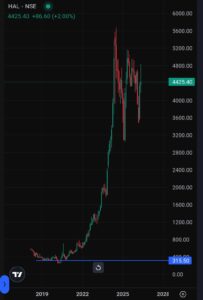
But now look at what happened to Apollo Micro Systems – a company that supplies specialised electronic systems and components to defence companies including HAL.
Apollo Micro Systems went from approximately Rs4 to Rs400 – a return of 100x.
Same sector. Same time period. Same defence boom that drove HAL’s 13x return. But the component supplier delivered 100x – nearly 8 times more return than the famous company everyone was watching.
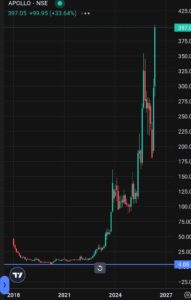
HAL got the attention. Apollo Micro Systems got the returns.
This is not an isolated example. This pattern repeats itself across every major sector in India and it has been repeating for decades. At Sharelesh, we teach students to always ask one question when a sector starts growing: “Who is supplying the components to the companies in this sector?” That question leads you to where the real multibaggers are hiding.
Current Indian Sectors and Their Hidden Supplier Multibaggers 2026
Based on current sector trends in India, here are the demanding sectors and the supplier spaces where the next generation of multibaggers are quietly building:
Electric Vehicles – The Sector Everyone Sees
What everyone buys: Tata Motors, Ola Electric, Bajaj Auto EV division
Where to look instead: Companies supplying lithium cells, BMS (Battery Management Systems), copper wiring harnesses, EV charging components, motor controllers, and lightweight aluminium components to EV manufacturers.
Defence – The Sector Making Headlines
What everyone buys: HAL, BEL, DRDO-linked PSUs
Where to look instead: Companies supplying defence electronics, radar components, precision engineering parts, specialised alloys, and communication systems to the large defence PSUs.
Defence electronics and EV components offer the most visible multibagger pipeline for 2026 onwards. The HAL and Apollo Micro Systems example is the living proof of this principle already playing out in the defence sector.
Specialty Chemicals – The China Plus One Opportunity
What everyone buys: Large chemical companies already known for exports
Where to look instead: Smaller specialty chemical companies supplying intermediates, APIs (Active Pharmaceutical Ingredients), and specialty compounds to both pharmaceutical and agrochemical manufacturers.
Specialty chemicals have historically been concentrated among India’s multibagger stocks, driven by the China plus one theme where India gains export share from China. The supplier companies in this space – making the chemical building blocks that larger companies need – carry lower valuations and higher growth potential.
Pharma – The API and Ingredient Suppliers
What everyone buys: Sun Pharma, Dr Reddy’s, Cipla
Where to look instead: Companies supplying Active Pharmaceutical Ingredients, drug intermediates, and specialised packaging to large pharma manufacturers.
When large pharma companies grow their export business, their API suppliers grow with them – often faster, because the API supplier serves multiple large pharma companies simultaneously.
Railways and Infrastructure
What everyone buys: IRFC, Rail Vikas Nigam, large infrastructure PSUs
Where to look instead: Companies supplying railway components – signalling systems, track components, coach parts, and specialized electrical systems to railway manufacturers and contractors.
Key Fundamental Criteria - What to Look for Before Investing
Once you have identified a potential supplier multibagger, these are the fundamental filters that separate genuine compounders from value traps.
Consistent Revenue Growth: Look for 20%+ revenue CAGR over at least 3 consecutive years. One good year means nothing. Consistent growth across multiple years means the business model is working.
High Return on Equity: A sustainable ROE of 20% or above is the minimum threshold for genuine multibagger candidates. India’s best compounders have maintained 25–35% ROE over extended periods. Consistency matters more than a single exceptional year.
Low Debt: For non-financial companies, a debt to equity ratio below 0.5 is ideal. Low debt means the company’s growth is self-funded, not dependent on expensive borrowing that eats into profits.
Expanding Margins: A company whose profit margins are growing year on year not just revenues – is building pricing power. Pricing power is what allows a supplier to extract value from the sector’s growth rather than just passing it through.
Scalable Business Model: The supplier must be able to grow its capacity without a proportional increase in costs. This scalability is what drives the profit multiplication that creates multibagger returns.
Warning Signs - How to Spot Fake Multibaggers and Pump and Dump Traps
Not every small supplier stock is a genuine multibagger. The Indian small cap space is full of stocks that look like multibagger candidates but are actually value traps or outright frauds. At Sharelesh, we teach students to watch for these warning signs.
Sudden volume spike with no fundamental news. If a small, unknown stock suddenly sees 10x its normal trading volume with no announcement, earnings surprise, or order win – it is likely being manipulated. Operators create artificial buying interest, attract retail investors, and then sell. The retail investor is left holding a worthless stock.
Promoter pledging increasing shares. When promoters are pledging their shares as collateral for personal loans, it means the people who know the business best do not have confidence in its near-term prospects. This is a serious red flag regardless of how attractive the stock looks on a screener.
Vague or unverifiable business claims. Some small companies claim to supply to large sector players without verifiable contracts or public announcements. Always verify supplier relationships through annual reports, exchange filings, and management conference calls before investing.
No institutional interest despite years of good fundamentals. If a stock has supposedly great fundamentals for 5+ years but zero institutional ownership – no mutual funds, no FIIs – ask why. Sometimes there is a legitimate reason. Often it means the fundamentals are not as strong as they appear.
Social media recommendations. Any stock being aggressively promoted on Telegram channels, WhatsApp groups, or YouTube channels as a “sure multibagger” should be treated with extreme suspicion. Genuine multibaggers are found through research – not through viral messages.
The Sharelesh Framework - How We Teach Students to Find Real Multibaggers
At Sharelesh, multibagger stock research is not about tips or recommendations. It is about teaching students a repeatable, logical framework that they can apply independently – across any sector, in any market cycle.
Our framework has five steps:
Step 1 – Sector Identification: Find sectors with government policy tailwind, rising budget allocation, and clear long-term demand growth.
Step 2 – Supplier Mapping: Identify the companies supplying components, raw materials, and specialised systems to the large players in that sector.
Step 3 – Fundamental Screening: Apply the four filters revenue growth, ROE, debt level, and promoter holding to shortlist genuine candidates from the supplier universe.
Step 4 – Institutional Discovery Check: Look for supplier companies where institutional holding is currently low but fundamentals are strong. This is the window before the rerating.
Step 5 – Patience and Position Management: Enter with a clear investment thesis, defined position size, and the patience to hold through normal volatility. Even the best multibagger candidates can take 5–10 years to fully rerate – impatient capital destroys the wealth-creation potential.
This framework is what we teach at Sharelesh – not stock tips, not hot picks, but a research process that students can own and repeat for a lifetime.
Common Mistakes Investors Make While Hunting Multibagger Stocks
After 17+ years of teaching stock market investing at Sharelesh, these are the most expensive multibagger-hunting mistakes I see repeatedly.
Mistake 1 – Buying after the stock has already run up. The biggest mistake retail investors make is chasing a stock after it has already doubled or tripled. By then, the easy money has been made by those who identified it early. Buying a supplier stock after it becomes famous defeats the entire purpose of the strategy.
Mistake 2 – Focusing on the sector, not the supplier. This is the core mistake this entire blog addresses. Buying HAL instead of Apollo Micro Systems. Buying the EV manufacturer instead of the battery component maker. The sector gets the attention. The supplier gets the returns.
Mistake 3 – Impatience. Multibagger returns take time. A genuine supplier multibagger might do nothing for 12–18 months after you buy it and then rerate 5x in six months when an institution discovers it. Investors who sell during the quiet period miss the entire return.
Mistake 4 – No research – just screener output. A stock that passes a screener is a starting point for research – not a buy signal. Visiting the company’s website, reading annual reports, listening to management conference calls, and verifying supplier relationships are all part of the process that separates genuine multibaggers from look-alikes.
Mistake 5 – Buying too many stocks. Diversification in small cap supplier stocks dilutes returns. If you own 30 supplier stocks hoping one will be a multibagger, the one that goes 10x gets cancelled out by the five that go to zero. Concentrate in fewer, better-researched ideas.
Frequently Asked Questions About Multibagger Stocks in India
Q: What is a multibagger stock in simple terms?
A multibagger stock is a stock that delivers returns of 2x, 5x, 10x, or more from its purchase price. For example, Apollo Micro Systems going from Rs4 to Rs400 is a 100-bagger – meaning every Rs1,000 invested became Rs1,00,000.
Q: Where should I look for multibagger stocks in India?
At Sharelesh, we teach students to look in the supplier and component companies that serve high-demand sectors not in the sector companies themselves.
Q: How do I find supplier companies for a sector?
Read the annual reports of large companies in the booming sector. Their vendor and supplier lists are publicly available.
Q: How long does it take for a multibagger to deliver returns?
Genuine multibaggers typically take 3 to 7 years to fully deliver their returns. The wealth creation happens in stages often quietly for 1-2 years.
Q: Should beginners try to find multibagger stocks?
Multibagger hunting requires patience, research skills, and emotional discipline that take time to develop. Rush it and you are more likely to fall for pump-and-dump traps than find genuine compounders.
Disclaimer: The content shared on this blog is purely for educational and informational purposes related to the stock market and trading. We do not provide any financial advice, investment recommendations, or profit guarantees. Trading and investing involve market risk.