
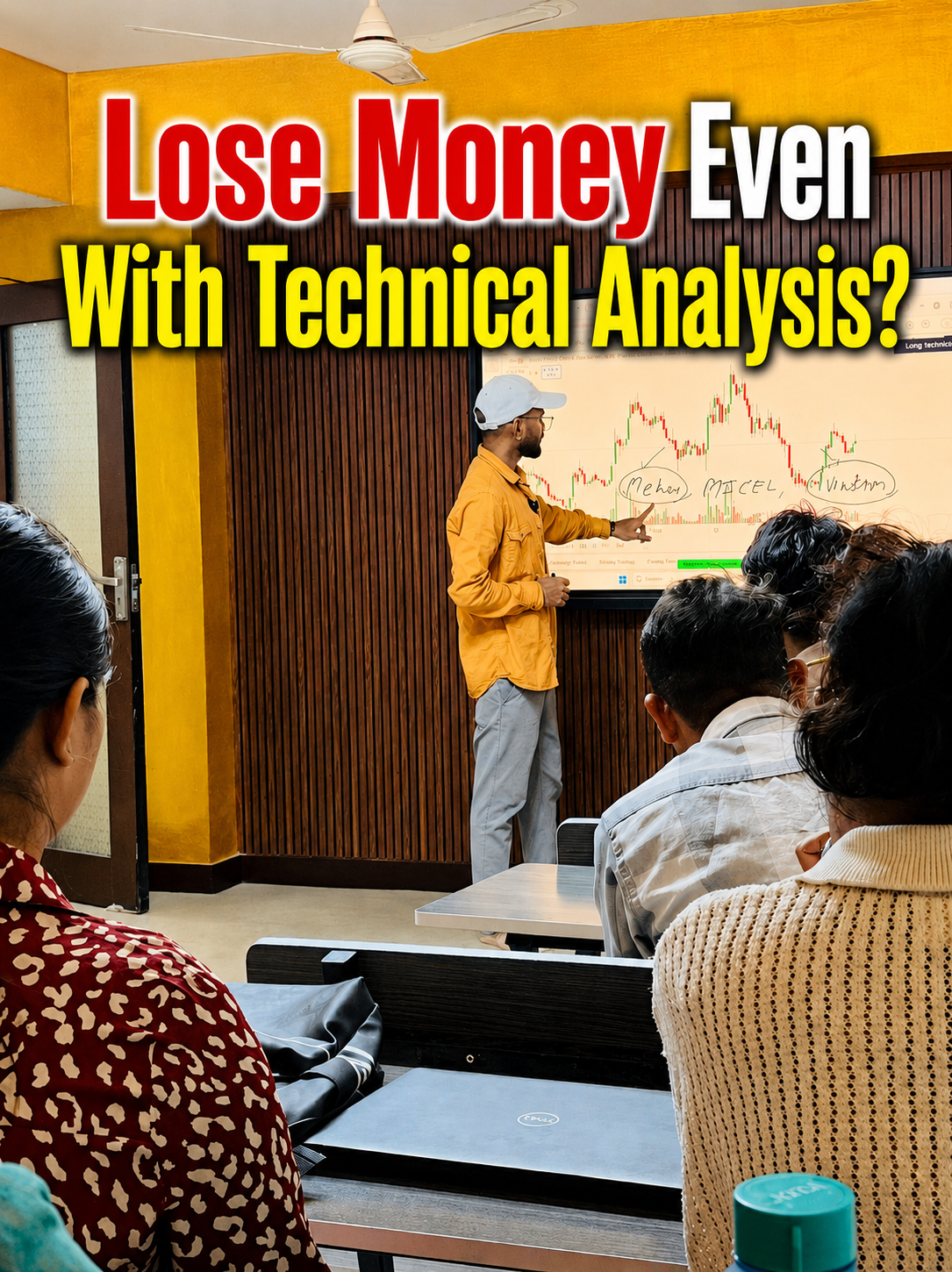
Why Do F&O Traders Lose Money Even With Technical Analysis? The Real Answer
Many F&O traders lose money even when they understand technical analysis because reading a chart correctly is only one part of trading. Technical analysis can help identify trends, support and resistance, momentum, and potential entry points but it cannot control your emotions, determine how much capital you should risk, or stop you from taking trades that don’t match your plan.
After 17+ years in the markets and teaching thousands of students at Sharelesh, I have repeatedly seen the same pattern: traders often don’t lose because they cannot read charts. They lose because they cannot consistently execute what their analysis tells them to do.
FOMO, revenge trading, excessive position sizing, moving stop losses, overtrading, and trading F&O without a strong equity-market foundation can turn a technically correct analysis into a losing trade.
So the real question isn’t:
“Does technical analysis work?”
The better question is:
“Why does technically correct analysis still fail to produce consistent results for many F&O traders?”
Let’s break it down.
Can Technical Analysis Make You Profitable in F&O Trading?
Technical analysis is useful, but it is not a complete trading system.
Let us be completely clear about one thing first. Technical analysis works. Support and resistance levels are real. Candlestick patterns carry genuine information about price behavior. Indicators, when used correctly, improve the quality of entry decisions.
However, technical analysis is a tool – not a complete trading system. And confusing the two is the most expensive mistake most F&O traders make.
Think of it this way. A hammer is an excellent tool. But knowing how to use a hammer does not make you a builder. A builder also needs to understand structural engineering, material quality, weather conditions, and most importantly how to build a strong foundation before adding floors above it. The hammer is just one part of a much larger skill set.
Technical analysis is your hammer. The question is – do you have everything else a trader needs to build consistent profits? Most F&O traders who lose despite knowing technical analysis are missing the foundation not the tool.
What Technical Analysis Can Tell You - And What It Cannot
Understanding the exact limitations of technical analysis is the first step towards fixing why it is not working for you. At Sharelesh, we teach students to be very clear about what their tools can and cannot do.
What Technical Analysis CAN Tell You
- Where price has historically found support and resistance – levels where buyers and sellers have previously shown strong interest
- The current trend direction – whether price is making higher highs and higher lows or lower highs and lower lows
- Momentum – whether price movement is accelerating or slowing down
- Potential entry and exit zones – areas where the probability of a price reaction is historically higher
- Pattern recognition – formations that have preceded similar price moves in the past
What Technical Analysis CANNOT Tell You
- How to control your emotions when the trade moves against you – no indicator tells you how to sit still when your stop loss is about to be hit
- Who is on the other side of your trade – your chart cannot tell you that an algorithm with crores of rupees in computing power is positioned against your entry
- Whether you are ready to trade today – your emotional state, your recent loss history, your psychological readiness – none of this appears on a chart
This gap between what technical analysis tells you and what you actually need to trade profitably is exactly where most F&O traders lose their money.
7 Reasons F&O Traders Lose Money Despite Good Technical Analysis
1. The Knowing-Doing Gap – When Emotion Overrides Your Chart Reading
At Sharelesh, we have a name for the most common and most expensive failure mode in F&O trading: the knowing-doing gap.
The knowing-doing gap is the distance between what your analysis tells you to do and what your emotions actually make you do in the heat of the moment.
You know the setup is weak but FOMO makes you enter anyway because the market is moving fast and you cannot bear to miss it. You know your stop loss is about to be hit but hope makes you move it further away because you are convinced the market will reverse. You know you have already hit your daily loss limit but frustration makes you take one more trade to recover.
In every one of these situations, your technical analysis was not wrong. Your execution was wrong. And execution is driven entirely by psychology – not by chart reading.
A correct chart reading means absolutely nothing if you cannot execute it without emotion. This is the truth that most trading courses, most YouTube channels, and most free content never tells you because it is the hardest truth to hear and the most difficult skill to build.
2. No Risk Management Despite Correct Entry Signals
Technical analysis tells you where to enter. Risk management tells you how much to risk. These are two completely separate skills, and many F&O traders focus heavily on finding the right entry while paying far less attention to protecting their capital.
At Sharelesh, we use a simple 30/70 framework to explain this: technical analysis is one part of trading, while risk management, psychology, and disciplined execution make up the larger part. This is not a mathematical rule or a guaranteed formula; it is a framework we use to help students understand why knowing where to enter is not enough to become a consistent trader.
Even a technically strong strategy will experience losing trades and losing streaks. If you risk too much on each trade, a relatively small number of losses can significantly damage your trading capital. Once your capital is heavily reduced, recovering it becomes much harder because you need disproportionately larger returns just to get back to where you started.
For example, if you risk ₹5,000 on every trade from a ₹50,000 account, a series of losses can quickly reduce your available capital and put emotional pressure on your next decisions. But if your position size is calculated according to your predefined risk limit, you give your strategy enough room to go through normal losing trades without putting your entire account at unnecessary risk.
This is why position sizing, stop-loss discipline, and maximum-loss limits are just as important as identifying an entry signal. A technically correct entry can still become a poor trade if the position is too large or the potential loss is not controlled.
Technical analysis helps you identify an opportunity. Risk management determines whether you can survive the opportunities that don’t work.
3. FOMO – Entering Trades Your Analysis Never Approved
FOMO is where technical analysis most visibly breaks down for F&O traders. The market makes a sharp move. Your chart did not show this setup in advance. There was no signal, no pattern, no technical reason to enter. But the move is happening right now, it looks powerful, and your group chat is buzzing with screenshots of profits.
So you enter not because your analysis approved the trade, but because you cannot emotionally tolerate watching a move without being part of it.
This is not technical analysis failing. This is technical analysis being completely bypassed by emotion. The chart never said to enter. You entered anyway. And when the trade fails as FOMO trades almost always do, because you entered late at the worst possible price you blame your technical analysis for a failure it had nothing to do with.
4. Trading Without a Written Plan in a Zero Tolerance Market
F&O is a zero tolerance market. Prices move fast. Expiry creates time pressure. Leverage amplifies every mistake. In this environment, making decisions in real time under emotional pressure without a written plan is not trading it is guessing with borrowed money.
A written trading plan specifies: which setup qualifies as an entry, exactly where the stop loss goes, exactly what the profit target is, the maximum number of trades per day, and the maximum loss for the session. Without this plan written down before the market opens, every decision during the session is made re-actively driven by what is happening on screen rather than what your analysis determined in advance.
Technical analysis performed calmly the night before is always better than technical analysis performed in real time while a position is moving against you. The plan created without emotional pressure is always superior to the decision made under it.
5. Revenge Trading – Trying to Recover Losses Instead of Following the Plan
One losing trade should never determine what you do with your next trade. But for many F&O traders, that is exactly what happens.
A trader enters a position based on a technical setup. The trade moves against them and the stop loss gets hit. Instead of accepting the planned loss and waiting for the next valid setup, frustration takes over. They immediately look for another trade because they want to recover what they just lost.
The second trade is usually taken with a different mindset. The trader is no longer asking, “Does this setup meet my rules?” They are asking, “How can I recover my Rs2,000 loss?”
That small change in thinking completely changes the quality of the decision.
The trader may increase the position size, enter without a proper signal, take a trade outside their strategy, or ignore their stop loss. If that trade also loses, the desire to recover becomes even stronger.
This creates a dangerous cycle:
Loss → Frustration → Unplanned trade → Bigger risk → More loss → Revenge
Technical analysis cannot protect a trader from this cycle because the problem is no longer the chart. The problem is the emotional objective behind the trade.
A disciplined trader treats every trade as an independent event. A losing trade is not a debt that the market owes you to recover.
The market does not know that you lost money on your previous trade.
Your next trade should therefore be based on your next valid setup—not on your desire to get your money back.
6. Overtrading — More Trades Do Not Mean More Opportunities
Another major reason F&O traders lose money despite understanding technical analysis is overtrading.
A trader may have a perfectly reasonable strategy, but instead of waiting for the specific setup their strategy requires, they start taking trades simply because the market is moving.
One trade becomes three. Three become seven. A trader who originally planned to take only two high-quality setups suddenly spends the entire session entering and exiting positions.
The problem is not necessarily that every individual trade is technically terrible. The problem is that most of those additional trades were never part of the original strategy.
This is where traders often confuse market activity with opportunity.
A market can move hundreds of points without giving you a valid setup.
You do not have to participate in every movement.
Overtrading also increases the impact of brokerage, taxes, spreads and other trading costs. More importantly, every additional decision creates another opportunity for emotional mistakes.
A disciplined trader understands that not trading is also a decision.
If your setup has not appeared, there is nothing to trade.
Technical analysis is supposed to help you identify when an opportunity exists. It should not become a reason to constantly search for opportunities where none exist.
The goal is not to take more trades.
The goal is to take better-quality trades that match your predefined rules.
7. Trading F&O Without Understanding the Underlying Market
One of the biggest mistakes I see among beginners is jumping directly into F&O because the potential returns appear much larger than those available in equity trading.
They learn a few candlestick patterns, understand calls and puts, watch option-chain videos, and believe they are ready to trade derivatives.
But F&O is not a shortcut to becoming a better trader.
Before trading derivatives, you need to understand how the underlying market behaves.
If you cannot identify basic market structure, understand demand and supply, recognise important support and resistance levels, manage a position and follow a stop loss in the underlying market, adding leverage does not solve the problem.
It magnifies it.
Consider the difference between these two approaches:
Trader A:
Learns the underlying market → develops a strategy → practices → understands risk → gradually moves toward derivatives.
Trader B:
Starts with options → uses leverage → follows tips/signals → increases position size after losses → tries to recover quickly.
Both traders may know the same technical indicators.
But they are operating with completely different foundations.
This is why I strongly believe that beginners should build their trading foundation before moving into F&O.
At Sharelesh, we teach trading as a progression:
Market Foundation → Technical Analysis → Risk Management → Trading Psychology → Strategy → F&O
F&O should be an extension of your trading skills—not a substitute for them.
The objective is not to reach derivatives as quickly as possible.
The objective is to become capable of managing risk before you get there.
So, Does Technical Analysis Actually Work in F&O?
Yes, technical analysis can be useful in F&O trading, but it should not be treated as a complete trading system. It can help traders identify market structure, trends, support and resistance, momentum, and potential entry or exit areas. However, technical analysis alone cannot determine appropriate position size, control emotional decisions, manage risk, or guarantee that a trade will be profitable.
The problem for many traders is therefore not that technical analysis doesn’t work. The problem is using technical analysis without the risk management, discipline, psychology, and trading plan required to execute it consistently.
The Missing Piece - What Technical Analysis Will Never Teach You
After everything above, here is the honest summary of what technical analysis no matter how advanced – will never teach you:
- How to sit still in a losing trade and honour your stop loss without moving it
- How to take a loss and not immediately revenge trade
- How to manage the psychological impact of five consecutive losing trades
- How to identify when you are emotionally unfit to trade and should step away
- How to build the equity trading foundation that makes F&O decisions meaningful
These are not technical skills. They are trading skills. And they are built through structured education, supervised practice, and mentorship – not through watching more chart analysis videos.
Before F&O - Build Your Foundation First
At Sharelesh, we use a simple analogy that every student – regardless of education level – understands immediately.
If you want to build a house, what is the first thing you do?
Do you start with the second floor? Do you begin with the roof? Or do you first dig the ground and build a strong foundation?
The answer is obvious. No engineer in the world starts a building from the second floor. The foundation comes first. Always. Because without a foundation, every floor you add above it is at risk of collapsing.
F&O trading is exactly the same.
The F&O market – Nifty options, Bank Nifty futures, stock derivatives is built entirely on top of the equity market. The index is made of stocks. Options derive their value from those stocks. If the stocks move, the index moves. If the index moves, your option moves. The derivative is built on top of the underlying. Always.
So if you cannot read and trade equity stocks profitably, if you do not understand why a stock moves, how earnings affect price, how sector rotation works, how institutional buying looks on a chart, you do not have the foundation to understand why the derivative built on top of it is behaving the way it is.
Every student who comes to Sharelesh after losing money in F&O has skipped this foundation. Without exception. They went straight to the second floor before the ground floor was built. And the structure collapsed not because F&O is impossible to trade profitably, but because they tried to trade it without the foundation it requires.
At Sharelesh, this is our non-negotiable rule: equity first, always. F&O comes after you are consistently profitable in equity – not before.
When you trade F&O with an equity foundation under you, everything changes. You understand why the index is moving. You can read the underlying stocks that are driving the move. You know whether the momentum is real or a temporary spike. And your technical analysis – the same technical analysis that was failing you before suddenly starts working, because now you have the context to apply it correctly.
The foundation is not a delay. The foundation is the reason the structure stands.
If you understand technical analysis but still struggle with execution, risk management or trading psychology, the next step isn’t another YouTube strategy. It’s structured practice and feedback.
The Sharelesh Solution - What Profitable F&O Traders Do Differently
At Sharelesh, when a student who knows technical analysis but keeps losing in F&O comes to us, we give them the same four-step solution every time.
Step 1 – Learn equity trading first. Minimum 6 months before touching F&O. Go back to the equity market. Trade individual stocks. Learn how price moves in context in relation to sector, to index, to news, to earnings. Build your technical analysis skills where the stakes are lower and the feedback is cleaner. Become consistently profitable in equity before the derivative of equity deserves your attention.
Step 2 – Paper trade your F&O strategy for 3 months before going live. Once your equity foundation is solid, paper trade your specific F&O setup for a minimum of three months. Track every trade entry, exit, profit and loss, emotional state. This builds the muscle memory of execution before real money amplifies every emotion.
Step 3 – Backtest your technical setup on at least 100 historical trades. A setup that worked last week may be a random event. A setup that has worked across 100 historical instances has genuine statistical validity. At Sharelesh, we teach students to backtest before they trust because trading a setup you have not verified is not technical analysis. It is hope.
Step 4 – Master one setup completely before learning a second one. The traders who know 10 setups and use none of them consistently will always under-perform the trader who knows one setup and executes it with perfect discipline every time. Depth beats breadth in trading. Master one setup first. Everything else comes after.
Frequently Asked Questions
Q: Why do F&O traders lose money even when their technical analysis is correct?
Because technical analysis is only 30% of trading. The remaining 70% psychology, risk management, understanding theta decay, and having an equity foundation – determines whether that correct analysis translates into a profitable trade. At Sharelesh, we teach all four components together, because none of them work in isolation.
Q: Is technical analysis useless for F&O trading?
No, Technical analysis is necessary – but it is not sufficient. It tells you where to enter and where to exit. It does not tell you how much to risk, how to manage your emotions, or how theta decay is affecting your option premium. You need all of these to trade F&O profitably.
Q: Why does knowing technical analysis not make F&O trading profitable?
Because the market does not reward knowledge, it rewards correct execution under pressure. Knowing a setup intellectually and executing it calmly with real money when a trade is moving against you are completely different skills. The gap between knowing and doing is where most F&O traders lose their money.
Q: What should I learn before starting F&O trading?
At Sharelesh, our answer is always the same: learn equity trading first. The F&O market is built on equity. If you cannot read and trade stocks profitably, you do not have the foundation to understand derivatives.
Q: How do I stop emotional trading in F&O?
Write your trading plan before the market opens. Define your entry, stop loss, target, and daily loss limit in advance. When emotions are running high during market hours, your pre-written plan makes the decision — not your emotional state.
About the Author
Shailesh Kumar Founder – Sharelesh | Trader | Mentor | 17+ Years in Markets
Equity • Technical Analysis • Risk Management • Trading Psychology • F&O • Forex & Crypto
I did not start my trading journey knowing everything. Like most traders, I made mistakes, expensive ones. But those mistakes became the curriculum at Sharelesh.
Over 17+ years of trading and teaching, I have worked with thousands of students across India – salaried employees, business owners, college students, and retirees all with one common goal: building a real, sustainable trading career.
What makes Sharelesh different is not just what we teach – it is what we refuse to teach. No illegal offshore broker tips. No get-rich-quick options strategies. No social media shortcuts. Only what is legal, structured, and genuinely works in the Indian market.
If you’re starting from scratch, read our guide on how to learn the stock market from scratch.
If you are serious about building a trading career the right way — Sharelesh is where that journey begins.
Indore, Madhya Pradesh, India 🌐 [sharelesh.com] 📞 [9039501235]